Glassware
How to decant wine: how long, how to pour and how to clean a decanter
Most young red wines taste better after 30 minutes to an hour in a decanter, full bodied reds such as Cabernet Sauvignon, Syrah or Barolo after one to two hours, and light reds such as Pinot Noir need little time or none at all. Older wines are decanted to leave their sediment behind, then drunk soon after. Here is how long to decant each kind of wine, how to pour it, and how to clean the decanter afterwards.
Why decant wine at all
Decanting does two separate jobs. The first is air. A young red that has spent a few years sealed in a bottle can taste tight, tannic or closed when you first open it. Pouring it into a decanter spreads it out and lets oxygen reach a much larger surface, which softens the tannins and brings the fruit forward. A wine that smells faintly of struck matches when first opened often clears within half an hour.
The second job is sediment. As red wine and port age, colour and tannin slowly settle out as a dark, gritty deposit. It is harmless but unpleasant in the glass, and careful decanting lets you pour off the clear wine and leave the sediment in the bottle.
How long to decant red wine
Treat these times as a starting point. Taste the wine as soon as you pour it, then again after 20 minutes, and you will quickly learn how your favourite bottles behave.
Young, full bodied reds: one to two hours
Cabernet Sauvignon and Bordeaux, Syrah and northern Rhône, Malbec, Barolo, Barbaresco, Brunello and big Australian Shiraz all have firm tannins when young. Give them at least an hour. A young Barolo can happily take two or more.
Medium bodied reds: 30 minutes to an hour
Merlot, Rioja Crianza and Reserva, Chianti Classico, Côtes du Rhône, Zinfandel and most everyday reds sit here. Half an hour is usually enough to round them off.
Light reds: up to 30 minutes, or not at all
Pinot Noir, Beaujolais and other Gamay, and most lighter Loire reds have delicate aromas that fade with too much air. Pour them straight into the glass, or give them 15 to 20 minutes if they seem closed.
Older reds: just before serving
A red of 15 years or more is fragile. It goes into the decanter to lose its sediment, not to breathe. Decant it shortly before you sit down and drink it within the hour, because old wine can fade quickly once it meets the air.
Port and white wine
Vintage port throws a heavy crust and always needs decanting. Stand the bottle upright for a day or two beforehand, pour it off carefully, and it will usually hold well for several hours. Full bodied whites such as oaked Chardonnay or white Burgundy can open up after 15 to 30 minutes in a decanter, kept cool. Sparkling wine should not be decanted at all.
How to use a wine decanter
For a young wine with no sediment there is no technique to learn. Open the bottle and pour it into the decanter in one go, letting it splash against the glass. The splash adds air, which is the whole point.
For a wine with sediment, take more care. Stand the bottle upright for at least a few hours, ideally a full day, so the sediment slides to the bottom. Open it without shaking it. Hold the decanter at an angle and pour slowly and steadily in one continuous movement, so the wine runs down the inside of the glass. Shine a torch or a candle under the neck of the bottle as you pour, and when the first dark threads of sediment reach the neck, stop. The last centimetre or so stays behind.
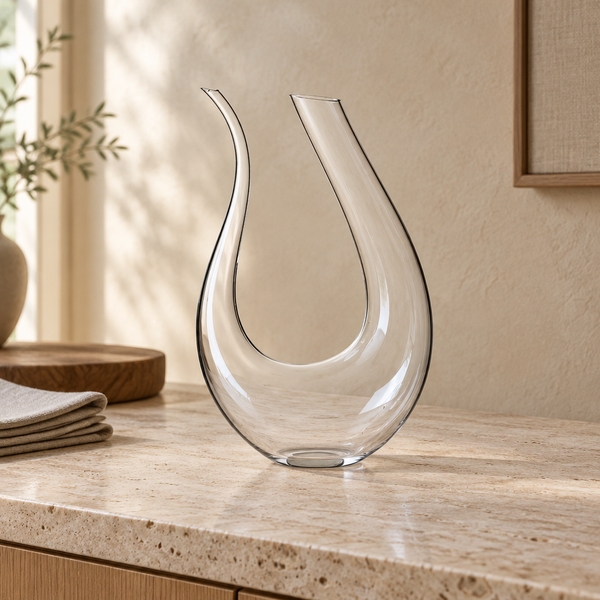
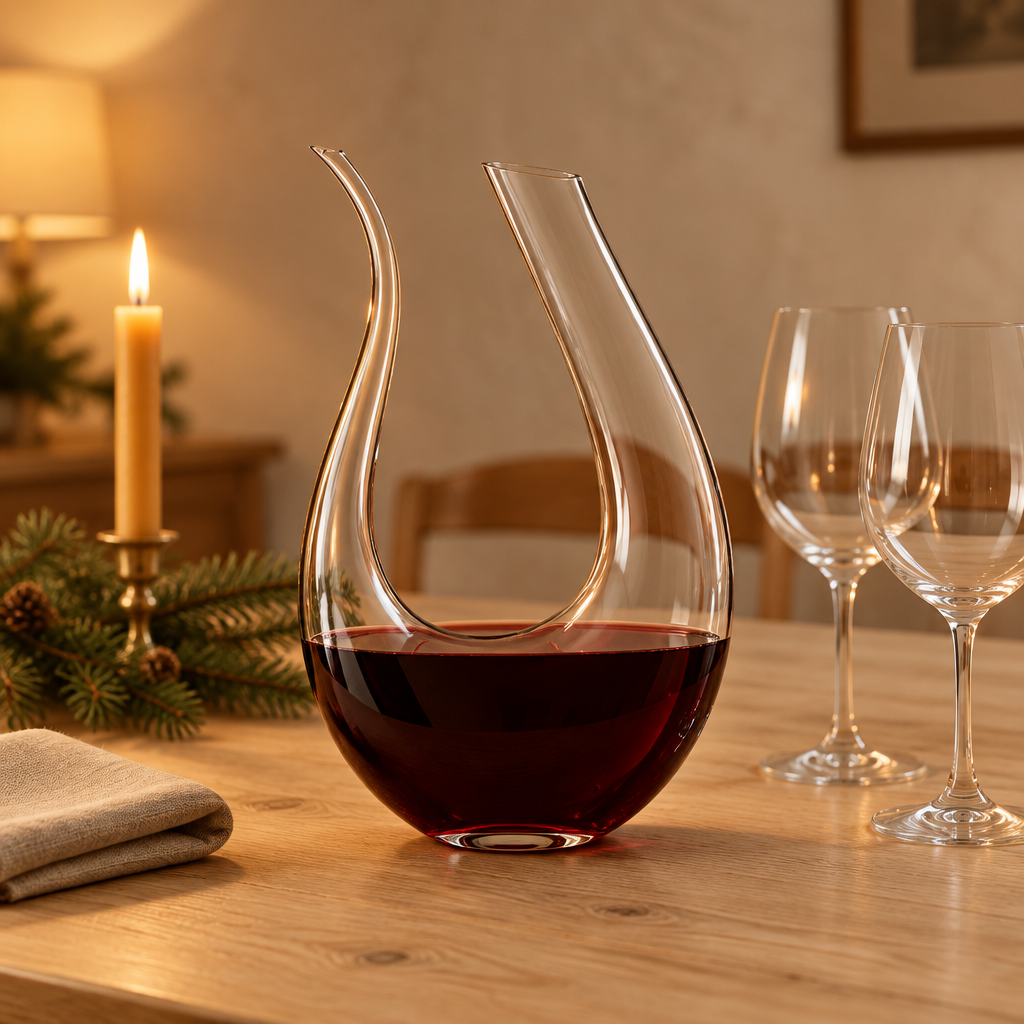
The shape of the decanter matters most for young reds, because a wide base gives the wine more surface to breathe. The Ginowan swan glass wine decanter is a single curve of handmade clear glass: a wide, low bowl that rises into a long swan neck. You pour the wine in through the top, let it open up in the broad base, then pour from the same opening, with the curved neck working as a handle. The maker lists it at 1500 ml, so a standard 750 ml bottle sits in the base with plenty of space above. It is handmade, so each one varies slightly, and the glass is fine and light.
Serving temperature in a warm house
The old advice to serve red wine at room temperature comes from rooms without central heating. A modern UK living room at 21°C is too warm for most reds, which start to taste soft and alcoholic. Aim for 15 to 18°C for fuller reds and 12 to 14°C for lighter ones such as Pinot Noir.
Wine in a wide decanter warms quickly on a warm table. If the bottle has been sitting near a radiator, 20 minutes in the fridge before you decant it brings it back to the right temperature, and the decanter can then wait somewhere cool while the wine breathes.
Pouring into the right glass
A decanted red deserves a glass with room to swirl. Fill it only to about a third, at the widest point of the bowl, so the aroma can gather in the space above the wine.
The Izumi fluted wine glasses are sold as a pair in five sizes from 230 ml to 665 ml, all with the same fine vertical ripple on a tall, slim bowl. The 590 and 665 ml sizes suit fuller reds, and 350 or 430 ml suits white wine or an everyday red. For a wider, rounder bowl, the Susono wine glasses are very thin clear glasses in 650 ml or 800 ml, the larger a Burgundy style glass that gives a red plenty of air. Both are best washed by hand. You will find more in glassware and carafes, and ideas for laying the rest of the table in our table setting guide.
How long wine keeps in a decanter
Plan to finish decanted wine the same evening. After several hours most reds begin to lose their fruit, and by the next morning they taste flat. If some is left over, pour it back into the bottle through a small funnel, push the cork back in and keep it in the fridge. Most reds will be fine for another day or two; take the bottle out half an hour before you want to drink it.
How to clean a decanter
Rinse the decanter with warm water as soon as it is empty. Wine left to dry inside leaves a red tide mark that is much harder to shift the next day. Rinse again until the water runs clear.
Avoid washing up liquid if you can. It leaves a film inside a long necked vessel that is hard to rinse out, and it can taint the next bottle. If water alone is not enough, a handful of crushed ice and a tablespoon of coarse salt with a splash of water, swirled round for a minute, will scour the glass gently. For a stubborn stain, fill the decanter with warm water and a spoonful of white vinegar, or warm water and a small handful of uncooked rice, swirl it well and leave it to soak. Rinse thoroughly afterwards. Never use a stiff brush or anything metal inside fine glass, as it scratches.
Avoid sudden changes of temperature, such as hot water poured into a cold decanter, and keep fine handmade glass out of the dishwasher. Leave it to dry upside down, as the maker of the Ginowan recommends; a folded tea towel in a deep bowl makes a steady place to drain it.
For red wine on a tablecloth, see our guide to washing and caring for linen.
Questions
Can you decant wine for too long?
Yes. A young, tannic red can sit for two or three hours quite happily, but lighter and older wines lose their aroma within an hour or so. If in doubt, decant for less time and let the wine carry on opening in the glass.
Is it worth decanting an inexpensive red?
Often more than an expensive one. Young, inexpensive reds can taste harsh straight from the bottle, and half an hour in a decanter softens them noticeably.
Should you decant Pinot Noir?
Usually not for long. Pinot Noir is light and aromatic, so 15 to 20 minutes is plenty and many are best poured straight into the glass. An older bottle with sediment can be decanted just before serving.
How do you get stains out of a decanter?
Swirl crushed ice and coarse salt with a little water, or soak it in warm water with a spoonful of white vinegar, then rinse well. Rinsing with warm water straight after use stops most stains forming in the first place.
The pieces in this guide
Everything named above, with the price on it. Free delivery, tracked to your door, and the delivery window stated before you pay.