Guide
Are paper lamps safe? Bulbs, placement and care for rice paper lamps

Paper lamps are safe when you use an LED bulb within the lamp's rated wattage, keep the bulb from touching the paper and place the lamp away from heat, flames and damp. Modern LED bulbs run far cooler than the old incandescent and halogen bulbs that gave paper shades their reputation, so a well made rice paper lamp is a safe, everyday light. Here is how to choose the bulb, where a paper lamp works best and how to keep the shade clean.
Why people worry about paper lamps
Paper burns, and for most of the last century the bulbs inside paper lanterns were incandescent. An old incandescent bulb turned most of its energy into heat rather than light, and halogen bulbs ran hotter still. A 100 watt bulb sitting close to a paper shade could scorch it, and a lantern that had slipped so the bulb touched the paper was a genuine risk.
LED bulbs changed that. An LED that gives the same light as an old 60 watt bulb uses only around 8 to 9 watts and runs much cooler; the glass is warm to the touch rather than hot. That is the main reason paper lamps are back in so many homes.
Choose an LED bulb, and check the rating
Use only LED bulbs in a paper lamp or paper shade. Avoid incandescent and halogen bulbs entirely, even if you have a box of them in a drawer.
Check the maximum wattage on the lamp, its label or its instructions, and never go above it. With LEDs you will almost always be well under, but it is worth knowing the number.
Choose brightness by lumens rather than watts. Around 400 to 470 lumens, the light of an old 40 watt bulb, gives a soft glow for a bedroom or a corner. Around 800 lumens, the old 60 watt, is better if the lamp is your main light or you read by it.
For the colour, warm white at around 2700K suits paper best and gives the classic soft, golden glow. A frosted or opal bulb spreads the light evenly across the shade, while a clear filament bulb can show as a bright spot in the middle. Our guide to colour temperature explains the numbers.
Keep the bulb clear of the paper
The bulb should sit in the middle of the shade without touching it at any point. Most paper lamps are built so that a frame holds the paper away from the lamp holder; your job is to keep it that way.
Choose a bulb of a normal size and shape for the fitting, not an oversized globe that fills the shade. After moving a lamp, or if it has been knocked, check that the shade still sits straight and the bulb is centred. With a hanging paper lantern, make sure the wire frame is properly hooked onto the fitting so the lantern cannot slip down over the bulb.
Never drape a scarf, a cloth or anything else over a lamp to soften the light. Keep paper lamps away from candles, open fires, wood burners and heaters, and away from curtains that might blow against them.
Our paper lamps and how they are lit
The Chiran rice paper floor lamp is a single column of crinkled rice paper, 107 cm tall and 25 cm wide, with a metal lamp holder and an LED light source. A small remote sets the brightness, switches between warm 3000K, neutral 4500K and white 6000K light, and sets a timer, so it can switch itself off after you fall asleep. It runs from a USB cable, so it needs a USB plug adapter, which is not included.
The Gifu rice paper table lamp is rice paper stretched over a ribbed frame on three slim iron legs, 28 cm across and 47 cm tall, with a UK plug and an inline switch. It comes with an E27 three colour LED bulb that moves between warm, neutral and cool white when you switch it off and on again. Any E27 bulb fits, but if you replace it, choose another LED. The shade is handmade rice paper, so handle it gently, and it is not suitable for damp rooms. Our guide to choosing a table lamp covers bedside heights.
The Yame paper lantern shade is a plain round paper globe on a fine metal wire frame, 30 or 40 cm across. It is a shade only, for a ceiling pendant cord set with an E27 lamp holder, which is not included, and we recommend a low heat LED bulb inside it.
The Amagi paper cloud pendant is made of many folded white paper petals that gather around the bulb in a loose cloud, about 48 cm across in the medium size and 65 to 70 cm in the large. It arrives flat with the ceiling base, lamp holder, cable and an LED bulb with three light colours, and the petals are shaped by hand once unpacked. It is a hardwired ceiling light, so it should be fitted by a qualified electrician.
If you want the look without paper at all, the Gujo shoji floor lantern is inspired by Japanese shoji screens but made with frosted acrylic panels behind a lattice of pale camphor pine. It comes in 45, 60 or 90 cm heights, each 25 x 25 cm at the base, with a UK plug, and takes one E27 bulb; warm white LED is recommended.
Where paper lamps work, and where they do not
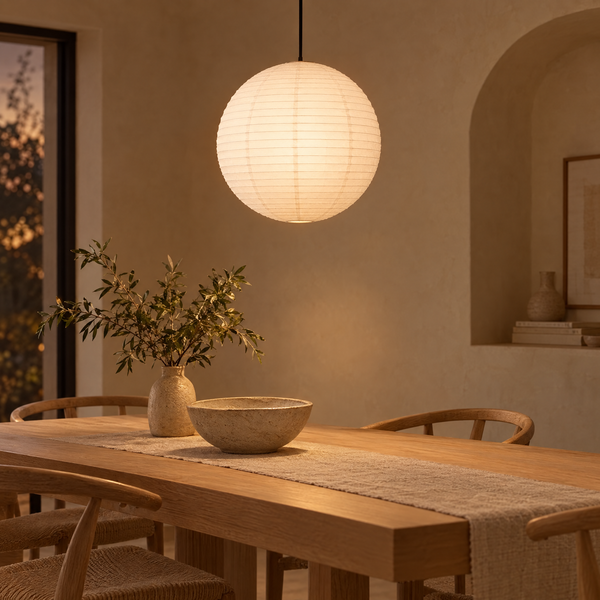
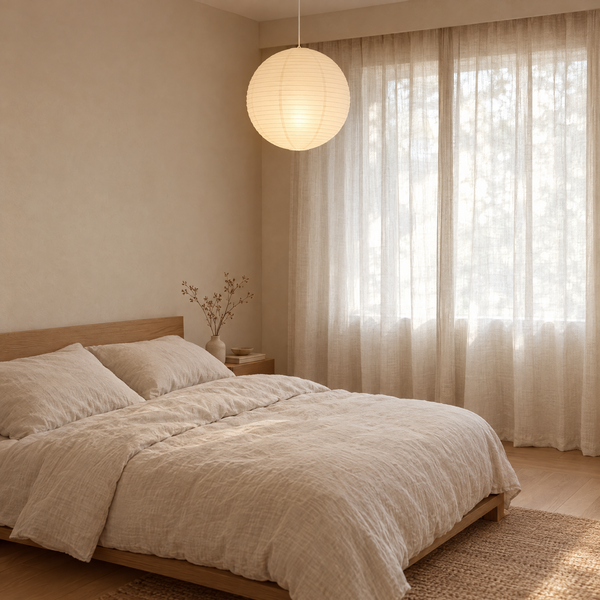
Paper lamps are at their best in bedrooms, living rooms, hallways and reading corners, anywhere you want soft, glare free light in the evening. A paper pendant over a dining table gives a calm glow, though you may want a brighter lamp nearby for tasks.
Keep them out of bathrooms and other damp rooms, as paper absorbs moisture, sags and can mark. Avoid the area around the hob, where steam and grease settle on the shade. Outdoors is not suitable unless a lamp is specifically made for it.
Think about who shares the room. Place floor lamps where they will not be knocked over by children, dogs or a cat on its way to the windowsill, and keep the cable tidy so nobody trips over it.
How to clean a paper lamp shade
Switch the lamp off and let the bulb cool first. Then work gently: paper tears and stains easily, and water is its enemy.
For everyday dust, use a soft, dry brush, such as a clean make up brush, a pastry brush or a soft paintbrush, and brush lightly along the ribs or folds. A hairdryer on its cool setting, held at a distance, blows dust out of crinkled paper and deep petals without touching them. A vacuum cleaner on its lowest suction with a soft brush attachment also works on a sturdy shade, if you steady the lamp with your other hand.
Never use water, a damp cloth or a cleaning spray on a paper shade. Little and often is the best approach: a light brush every few weeks stops dust settling into the fibres.
Paper is a natural material and can mellow in colour over time, especially near a sunny window. Some people like that softening. A lamp with a separate shade, like the Yame, also lets you replace just the shade when it has done its years.
A quick safety checklist
- LED bulb only, within the lamp's maximum wattage
- Bulb centred and not touching the paper
- Nothing draped over the shade
- Away from candles, fires, heaters and curtains
- Not in a bathroom, a damp room or outdoors
- Switched off when you go out or go to bed
See all our paper and lantern lamps in table and floor lamps and ceiling lights and pendants.
Questions
Can a paper lamp catch fire?
Any paper can burn if it gets hot enough, but a paper lamp with a cool running LED bulb that does not touch the shade is a very low risk. The real hazards are hot incandescent or halogen bulbs, a bulb touching the paper, or a lamp placed near a flame or heater.
What wattage bulb should I use in a paper lantern?
An LED of around 5 to 9 watts, which gives roughly the light of an old 40 to 60 watt bulb, suits most paper lanterns. Always stay within the maximum wattage shown on the lamp or its fitting.
Can you use a paper lamp in a bathroom?
No. Paper absorbs moisture, so it sags and marks in steam, and bathroom lights need a suitable IP rating. Use a fitting made for bathrooms instead.
How do you clean a rice paper lamp?
Switch it off, let it cool, then dust it with a soft dry brush or a hairdryer on a cool setting. Never use water or a damp cloth, which can stain and tear the paper.
The pieces in this guide
Everything named above, with the price on it. Free delivery, tracked to your door, and the delivery window stated before you pay.