Guide
How to choose a table lamp: height, shade, bulb and placement

To choose a table lamp, start with height: when you are sitting beside it, the bottom of the shade should be at about eye level, so you see a soft glow rather than the bare bulb. Then choose a shade narrower than the table, a material that gives the kind of light you want, and a warm white bulb of around 2700K. Here is how each of those decisions works, for a bedside, a sofa side table and a sideboard.
Get the height right first
Too short and the light pools on the table while your face stays in shadow; too tall and you look into the bulb. The simplest test is seated eye level. Sit where you will use the lamp and look straight ahead. The bottom edge of the shade should be roughly level with your eyes. For most sofas and armchairs that puts the bottom of the shade around 95 to 110 cm from the floor.
For a bedside lamp, sit up in bed as you would to read. For reading, the bottom of the shade should be at about chin height, so the light falls onto the page without shining in your eyes. Measure from the floor to your chin while sitting up, take away the height of the bedside table, and that is roughly how far above the table the bottom of the shade should sit. A smaller, lower lamp is fine for soft background light while you wind down, especially one that hides the bulb, such as a paper lantern or an opal glass globe.
As a rough rule of proportion, the lamp should be about the same height as the table it stands on, or a little taller. A lamp much more than one and a half times the height of the table tends to look top heavy.
Choose the shade width
The shade should be wider than the widest part of the base, or the lamp will look unstable. It should also be narrower than the table top, leaving a few centimetres clear on each side so the shade is not knocked every time someone puts down a cup.
On a small bedside table of 40 to 45 cm across, keep the shade below about 35 cm wide. On a sideboard or console, where the lamp has more room and is seen from further away, a wider shade of 35 to 50 cm looks more in proportion.
Shade material and the quality of light
The shade decides what kind of light the lamp gives, which matters more than its looks.
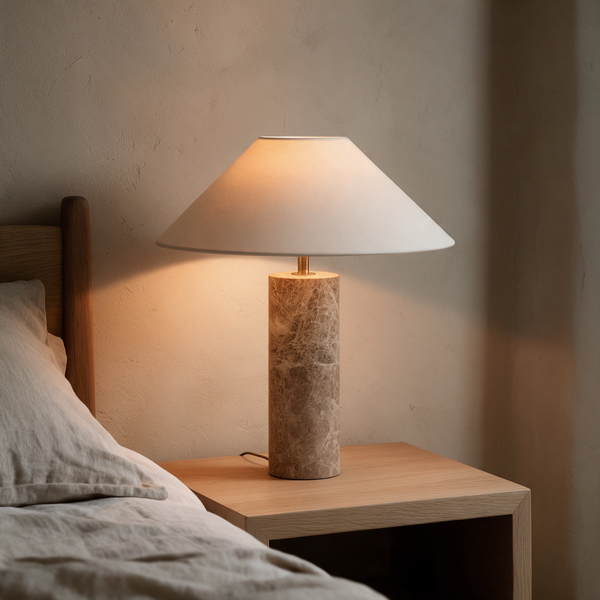
Fabric and linen shades are opaque or semi opaque, so they send light down onto the table and up towards the ceiling, with a soft glow through the sides. That makes a pool of light to read by without lighting the whole room. The Usuki marble table lamp has a wide, shallow off white fabric shade over a column of veined marble, in a small size 40 cm tall with a 30 cm shade, or a large size 46 cm tall with a 35 cm shade.
Paper shades glow all over. The light is soft and ambient rather than directional, which suits a bedroom or a corner where you want warmth more than brightness. The Gifu rice paper table lamp is rice paper over a ribbed frame on three slim iron legs, 28 cm across and 47 cm tall, with enough light to read by without filling the room.
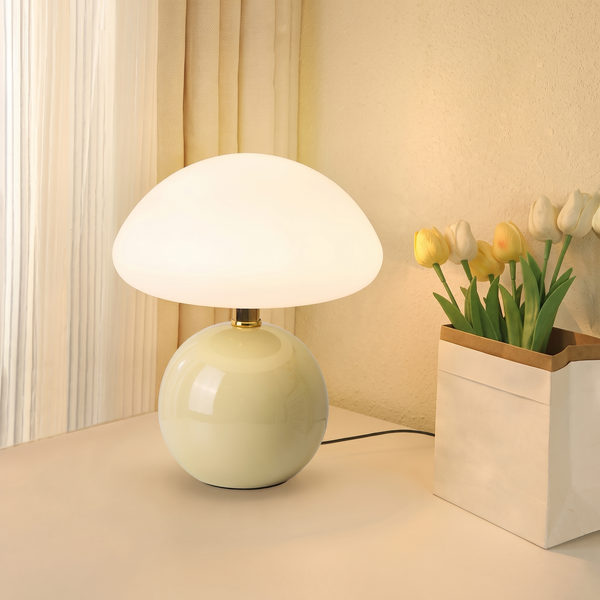
Opal or frosted glass gives an even, glare free glow. The Positano ceramic mushroom table lamp is 22 cm tall with a 19.3 cm glass dome in cream or white, and the Cortona travertine table lamp is a cube of unpolished travertine tilted on one corner, holding a 13 cm opal glass globe, 20 cm tall in all. Both are compact enough for a small bedside table.
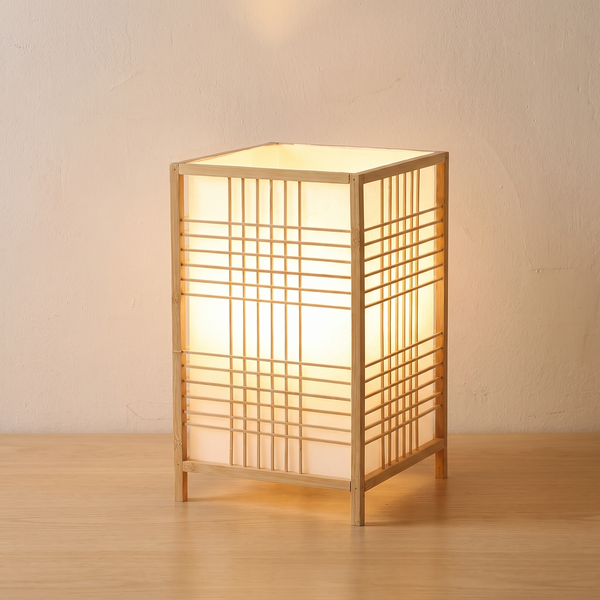
Open woven or slatted shades in rattan or bamboo throw patterns of light and shadow onto the wall, better for atmosphere than reading. The Fukuoka bamboo lantern lamp comes as a square grid lantern or a woven dome, both small enough for a desk or a shelf.
Bulbs and colour temperature
Check the fitting before you buy bulbs. Most table lamps take an E27 large screw, some an E14 small screw, and small lamps often take a G9 capsule.
For a living room or a bedroom, choose warm white at about 2700K. It is close to the colour of old incandescent bulbs and looks right with wood, linen and stone. Neutral white, around 4000K, suits a desk or a kitchen worktop. Our guide to warm, neutral and cool colour temperature goes into more detail.
For brightness, look at lumens rather than watts. Around 400 to 500 lumens, roughly what a 40 watt incandescent bulb gave, is plenty for a mood lamp. For reading, around 800 lumens is more comfortable. A dimmable lamp lets one lamp do both jobs.
Corded or cordless?
A corded lamp gives more light and never needs charging, so it is still the best choice for a main reading lamp or a large statement lamp. Look at where the switch is: an inline switch on the cable or a switch on the lamp itself is easier to reach from bed than one on the plug.
A cordless lamp runs on a built in battery and charges between uses. It can go where there is no socket: the middle of a dining table, a bookshelf, a windowsill or a bedside on the wrong side of the room. Most give a softer light than a corded lamp, so they are better for atmosphere than for long reading sessions. See our cordless lighting collection.
The Hodaka cordless table lamp looks like a traditional lamp, with a pleated or drum fabric shade, a stem that adjusts from 32 to 39.5 cm and a replaceable E12 bulb in warm 2700K. The Kobe cordless table lamp is a slim metal lamp 28.5 cm tall with a touch control on top for dimming and three light tones.
Bedside lamps and sideboard lamps
A bedside lamp needs to be compact, easy to switch on from bed, and soft enough not to wake a partner. Small paper, glass and fabric lamps all give a gentle light for winding down. If you read in bed every night, choose one tall enough for the shade to sit near chin height when you are sitting up. A pair, one each side, makes a bed look finished. Our guide to bedside wall light height covers the alternative if the tables are too small for a lamp.
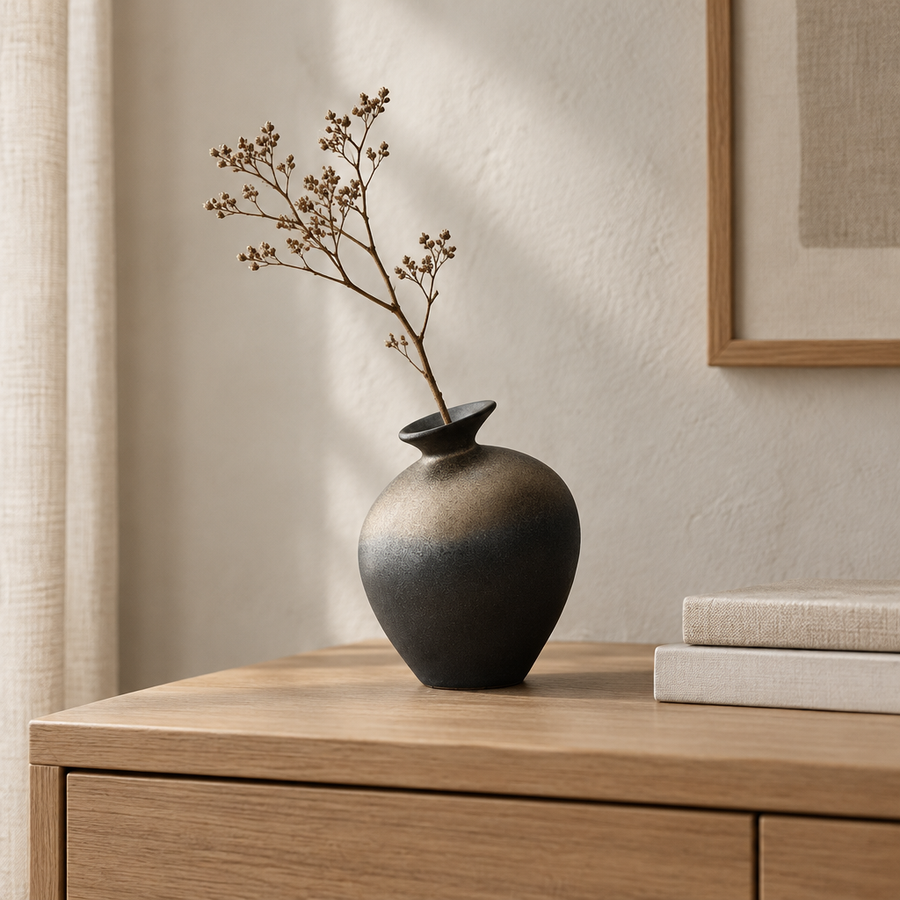
A sideboard or console lamp is seen from across the room, so it can be taller and wider, and it is as much about the look as the light. Place it towards one end, balanced by a vase or a stack of books at the other, or use a matching pair at each end. The Yanagawa scalloped shade lamp in its table size has a turned wood stem and a white pleated fabric shade with a scalloped edge, 32 cm across and 50 cm tall. The Iwaki woven rattan table lamp comes with a low globe base and a 27 cm shade for a bedside, or a tall base with a 35 cm coolie shade for a sideboard.
A quick checklist
- Bottom of the shade at seated eye level, or chin height in bed
- Shade wider than the base and narrower than the table
- Shade material chosen for the light you want
- Correct bulb fitting, warm white 2700K
- A switch you can reach from where you sit
See all our lamps in table and floor lamps, and for ideas on layering light through a room, our Japandi living room ideas.
Questions
How tall should a bedside lamp be?
If you want to read by it, tall enough for the bottom of the shade to sit at about chin height when you are sitting up in bed. Measure from the floor to your chin, take away the height of the bedside table, and that is roughly where the bottom of the shade should be. For soft background light, a smaller lamp is fine.
How tall should a lamp be next to a sofa?
The bottom of the shade should be roughly at eye level when you are seated, which is usually around 95 to 110 cm from the floor. To check, add the height of the side table to the height of the lamp, then take away the height of the shade.
What colour bulb is best for a table lamp?
Warm white, around 2700K, for living rooms and bedrooms. It gives a soft, cosy light, while neutral white around 4000K is better for a desk.
Are cordless lamps bright enough?
Most cordless lamps give a soft light that suits a dining table, shelf or bedside for atmosphere. For long reading sessions, a corded lamp with a brighter bulb is usually more comfortable.
The pieces in this guide
Everything named above, with the price on it. Free delivery, tracked to your door, and the delivery window stated before you pay.