Guide
Japandi living room ideas for a UK home
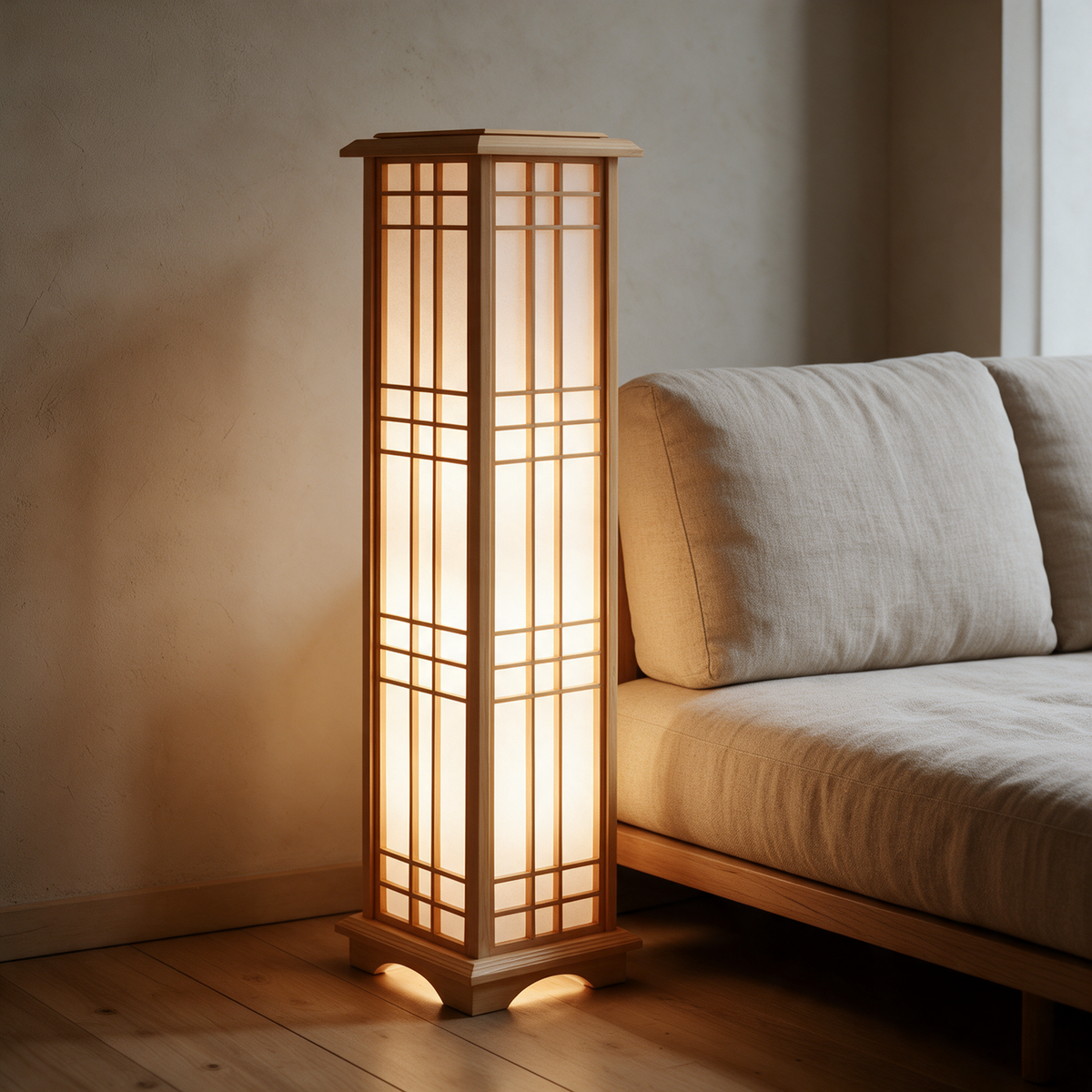
A Japandi living room feels calm because there is less in it, and because what remains is made of natural materials in a narrow range of warm colours. In practice that means a simple, low sofa, one or two pieces in wood or cane, linen and wool for softness, warm lamps at low level instead of one bright ceiling light, and closed storage for everything else. Here is how to apply that to a typical UK living room, chimney breast, radiators, grey winter light and all.
Start by taking things out
Japandi begins with editing, not shopping. Clear the coffee table, the mantelpiece and the windowsills completely, then put back only what you use or genuinely want to look at. A good test is that every surface should show more empty space than objects. Remote controls, chargers, post and the general drift of daily life need a home with a lid or a door: a lidded basket, a drawer or a cupboard.
If you are new to the style, our guide What is Japandi style? explains where it comes from and the ideas behind it.
Choose a warm, quiet palette
For much of the year UK daylight is soft and grey, and a north facing room may get no direct sun at all. In that light a bright brilliant white can look cold and slightly blue. Warm whites work better: off whites with a little yellow or pink in them, or soft putty, mushroom and pale clay tones.
Keep the large pieces, such as the sofa, curtains and rug, in oatmeal, sand, stone or cream. Then add a few darker notes for depth, which is where the Japanese side of the style comes in: charcoal, walnut, black, rust or moss green. Three or four colours plus the tones of the wood are usually enough for a whole room.
Furniture: low, simple and honest about its materials
Japandi furniture tends to sit low. Keeping the main pieces below the level of the windowsill lowers the eye line, which makes a room with a standard 2.4 m ceiling feel taller and more open. Look for a sofa with clean lines and visible legs, so you can see the floor underneath it, and a low coffee table in solid wood or stone with softened edges.
A second chair makes a living room feel finished, and it is a good place to bring in a different material. The Arita cane lounge chair sits close to the floor with a wide seat and a backrest set at an easy, reclined angle. Its rubberwood frame is joined with mortise and tenon joints and the seat and back are woven panels in an open cane pattern, so it looks light even though it is generously sized. Before you buy any chair for a smaller room, our guide to fitting an accent chair in a small room covers the clearances that matter.
Mix your woods rather than matching them. One pale wood and one darker wood looks considered; five slightly different browns looks accidental.
Make the chimney breast and alcoves work
Many UK living rooms are built around a chimney breast with an alcove on either side. Treat the chimney breast simply: one object on the mantelpiece, or one piece of art, and nothing else. Use the alcoves for storage, ideally closed cupboards at the bottom with a couple of open shelves above, kept sparse. Our guide to storage that does not look like storage has more ideas for hiding the everyday.
If the television has to live in the living room, a low media unit in one of the alcoves keeps the screen at a comfortable viewing height and stops it taking over the room. A dark wall behind it makes the black screen far less noticeable when it is switched off.
Layer the lighting low and warm
A single ceiling light flattens a room and throws shadows under everyone's eyes. A Japandi living room uses three or four sources at different heights: a floor lamp in a corner, a table lamp beside the sofa, and perhaps a pair of wall lights. Use warm white bulbs, around 2700K, for the evening. Our guide to colour temperature explains the numbers.
Paper and lattice lamps suit the style especially well because they diffuse the light. The Gujo shoji floor lantern sets a fine lattice of pale pine over frosted panels on all four sides, with the bulb hidden inside, so the light comes through evenly and softly. The tallest version, at 90 cm, is the one to put in a dark corner of the living room.
Bring in texture rather than pattern
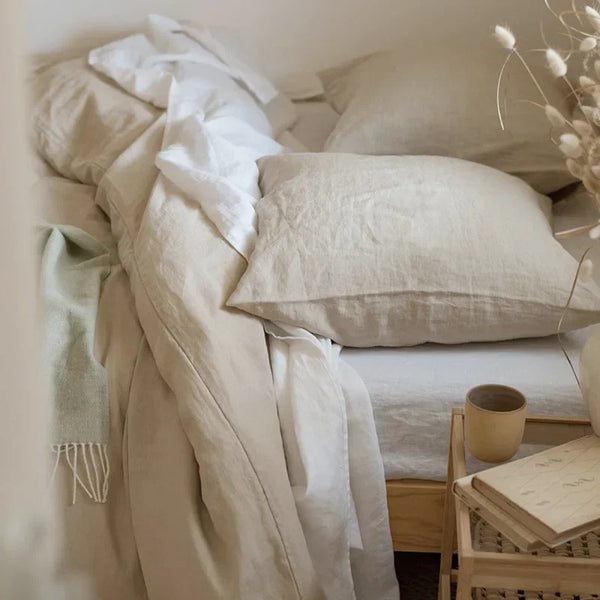
Japandi rooms rarely use bold prints. The interest comes from texture instead: the slub of linen, the ridges of wool, the weave of cane, the grain of wood and the surface of handmade clay.
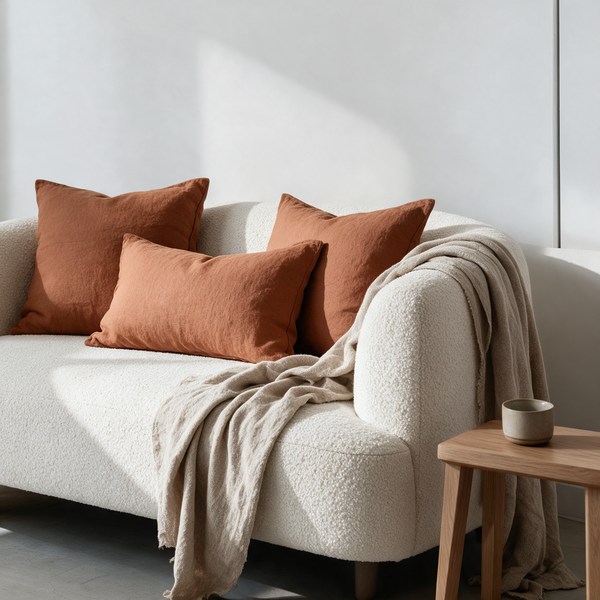
Cushions are the easiest place to start. The Yuki cushion cover is plain washed linen with an envelope opening at the back and no piping or zip, so it looks clean and slightly undone. Two or three colours on one sofa is plenty, for example natural with one in rust or moss.
Under the sofa, a rug pulls the seating together. It should be big enough for at least the front legs of the sofa and chairs to sit on it; a small rug floating in the middle of the floor makes a room look smaller. The Shirakawa braided wool rug has no printed pattern at all, just cords of braided wool laid in rectangles, one inside the next, in oatmeal, cream or light grey. The 160 x 230 cm or 200 x 300 cm sizes suit most UK living rooms.
Dress the windows in linen
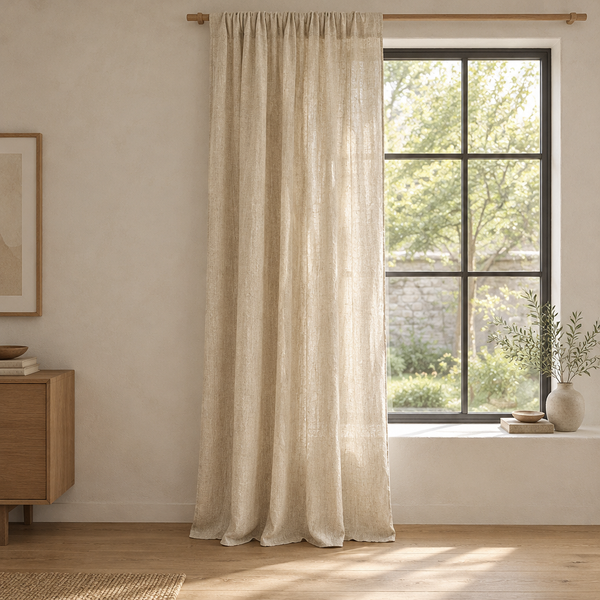
Linen curtains filter daylight into a soft glow rather than blocking it, which suits the style perfectly. Hang the pole higher and wider than the window frame, so that open curtains sit mostly against the wall rather than over the glass. The window looks bigger and the room gets more light.
Many UK living rooms have a radiator under the window. Floor length curtains drawn over a radiator trap the heat behind them, so either choose a drop that stops just above it or tie them back. The Ikaruga linen curtain is stone washed 100% linen in a mid weight, comes in drops from 160 to 260 cm and hangs from a simple rod pocket. It filters light rather than blacking it out, and it is sold as a single panel, so most windows need two.
A few handmade objects, not a collection
Wabi sabi, the Japanese appreciation of things that are imperfect, handmade and a little worn, is what keeps a Japandi room from feeling cold. Choose a small number of objects with visible signs of how they were made, and give each one space around it.
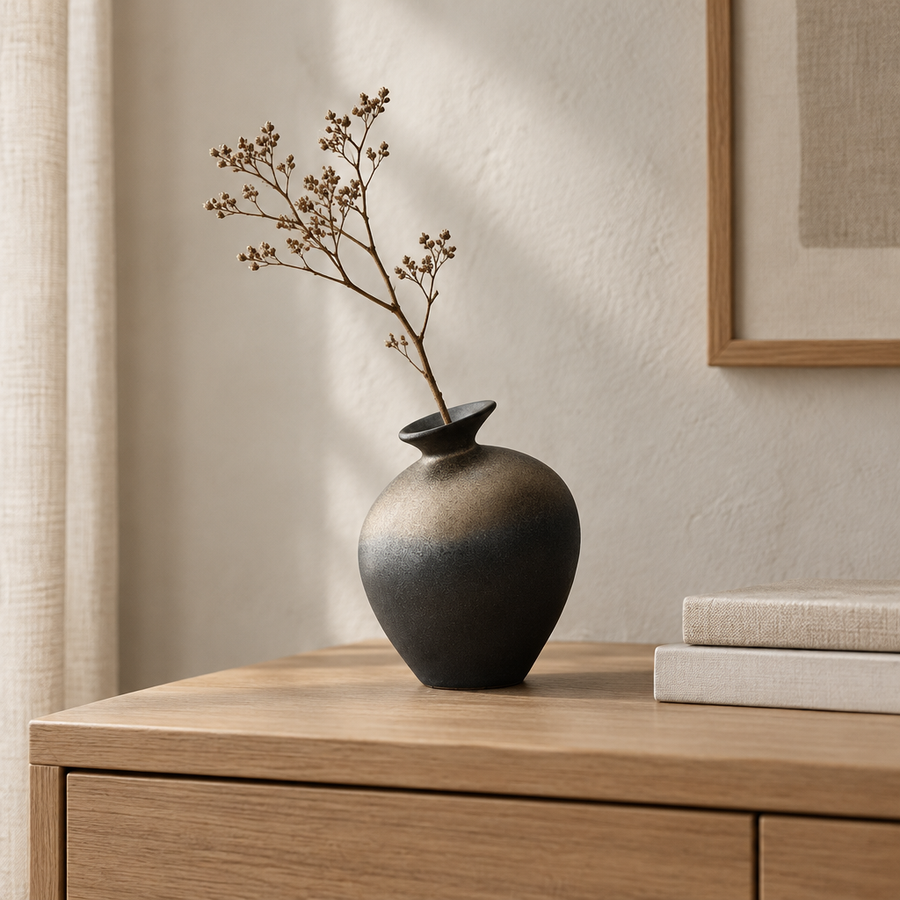
A single vase with one branch does more than a shelf of ornaments. The Tobe handmade clay vase is about 20 cm tall, left matte in a warm taupe with the rings from the potter's wheel still visible. A stem of eucalyptus, olive or berries is all it needs. Change the branch with the seasons and the room changes with it.
Where to start this weekend
Clear every surface and put back half. Swap any cool white bulbs for warm white and switch off the ceiling light in the evening. Then add one natural texture you can touch, such as linen cushions or a wool throw. Those three changes cost little and do most of the work. You can see our full range for the room in the living room collection, and ceramics in vases and ceramics.
The pieces in this guide
Everything named above, with the price on it. Free delivery, tracked to your door, and the delivery window stated before you pay.