Guide
Magnetic knife strips: are they bad for knives, and how to fit one
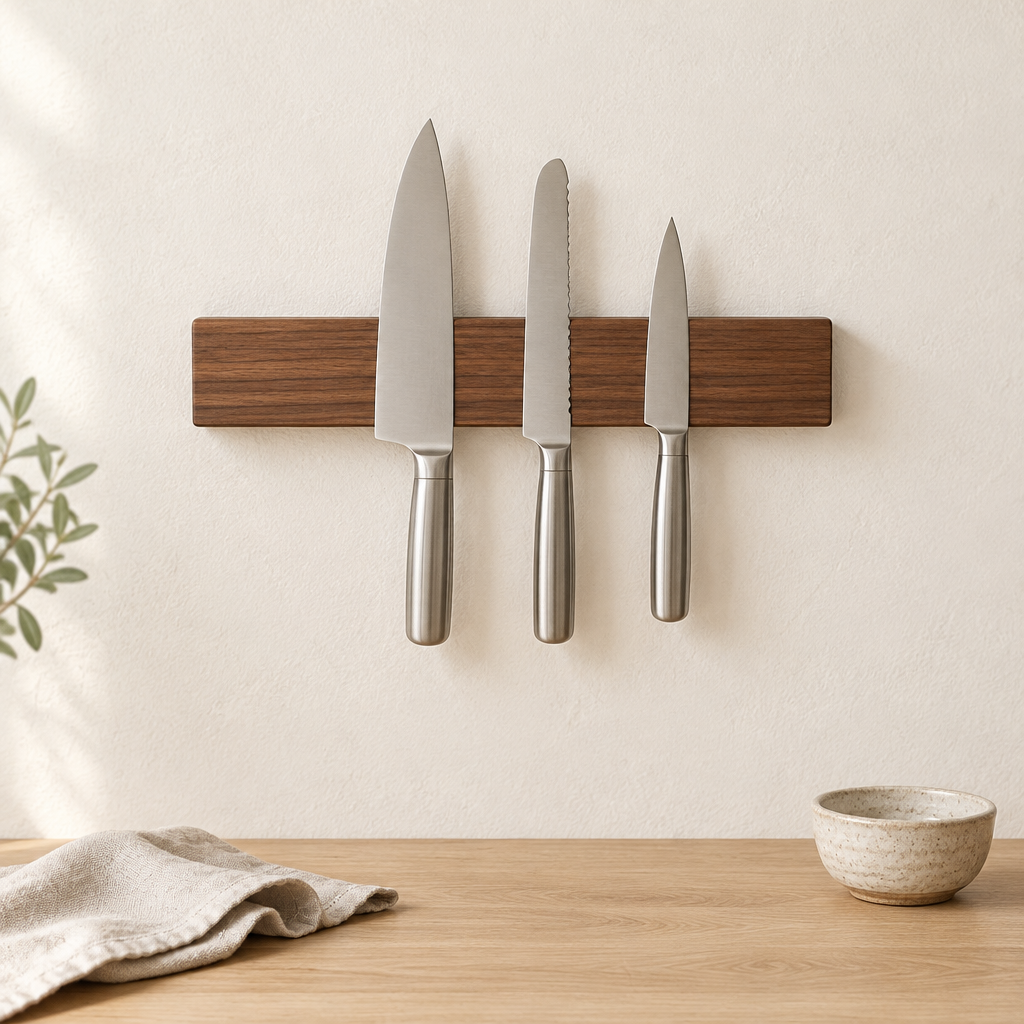
A magnetic knife strip is not bad for your knives, as long as you put each knife on and take it off the right way: spine first, rolling the blade flat, and never dragging the edge across the strip. A wooden faced strip is the gentlest kind, and because it keeps blades apart, dry and in sight, it is kinder to a good edge than a drawer. This guide covers how to use one safely, where and how high to put it, how to fix it to different walls, and how wood and steel strips compare.
Are magnetic knife strips bad for knives?
What damages a knife edge is knocks and grinding, not magnets. Knives loose in a drawer knock against each other every time it opens, and a knife block means sliding the blade through a slot that is hard to clean and slow to dry.
A strip holds each knife on its own, flat against the surface, in the open air where it dries properly. The only risk is in the handling. If a knife snaps onto the strip edge first, or is pulled off by sliding the edge along the face, the edge can chip or dull.
In normal use the magnets do not harm the steel. Ceramic knives will not stick at all, and some stainless knives hold only weakly, so test yours with a fridge magnet first.
How to put knives on and take them off
To put a knife on, hold it by the handle and touch the spine, the blunt back of the blade, against the strip first. Then roll the blade down flat. The magnet does the rest, and the edge settles gently instead of snapping onto the surface.
To take it off, do the same in reverse. Grip the handle, roll the edge away from the strip so the knife pivots on its spine, then lift it clear. Do not pull a knife straight off sideways or slide it downwards, because both drag the edge across the face.
Hang every knife the same way, usually handle up and blade down, so your hand always meets a handle. Leave a finger's width between knives so you can grip one without touching the next, and keep the knife you use most at the end nearest the chopping board.
Where to put a magnetic knife strip
The best place is the wall beside where you prepare food, close to where the chopping board lives.
Avoid the wall directly above the hob, where heat, steam and grease reach the knives and the wood, and the wall directly over the sink, where knives get splashed. Keep the strip away from doorways and walkways where someone could brush past the blades, and out of reach of small children. If there are young children in the house who can reach the worktop, a strip fixed inside a high cupboard door is a sensible alternative.
How high to fit it
Most UK kitchens have about 45 to 50 cm between the worktop and the bottom of the wall cupboards, and a knife strip fits well in that gap. The aim is for the tip of your longest knife to clear the worktop, and anything that stands on it such as the kettle, by a few centimetres, while the handles stay easy to grip without stretching.
The simplest way to find the height is to hold your longest knife against the wall, handle up, with the tip a few centimetres above the worktop or the appliance below. Mark the wall just below the handle: that is roughly where the top edge of the strip goes. If there are no wall cupboards, just below eye height is a good place to start.
How to fit a magnetic knife strip
A loaded strip pulls away from the wall, so it needs a proper fixing. Check what comes in the pack and use screws and plugs that suit your wall.
Before you drill anything, run a cable and pipe detector over the area. Cables usually run straight up, down or across from sockets and switches, and there are often sockets along the back of a worktop, so do not drill directly in line with one. Mark the holes with a spirit level so the strip sits straight.
Brick or block walls
Drill with a masonry bit sized to the wall plug, push the plug in flush with the wall, then screw the strip on. If the plaster is crumbly, drill a little deeper so the plug sits in the brick behind it.
Plasterboard and stud walls
Plasterboard sounds hollow when you knock on it. Either find a timber stud behind the board with a detector and screw into that, or use hollow wall anchors made for plasterboard. Ordinary plastic plugs on their own will not hold well in plasterboard.
Tiled walls
Put a piece of masking tape over the spot so the bit does not skid on the glaze. Start with a tile bit at a slow speed and with the hammer action off, then change to a masonry bit once you are through the tile and into the wall behind.
If you rent, ask your landlord before drilling. If drilling is not an option at all, a freestanding magnetic block gives you the same open storage on the worktop.
Wood or steel strips
Metal strips with exposed magnets are slim and inexpensive, but the knife meets metal every time it goes on. That makes a clack and can mark the faces of the blade.
A wooden strip hides the magnets inside the wood, so the blade rests against a softer surface that will not mark the steel. It is quieter, and it looks like part of the kitchen. The trade off is that wood needs a little care: wipe it with a dry cloth and never soak it.
The Tahara walnut magnetic knife rail is a solid walnut bar with strong magnets set inside, so from the front you see only the grain and no metal strip on the face. It is about 40 cm long and holds kitchen knives, scissors, a sharpening steel and steel spice tins. Very heavy cleavers are best kept elsewhere.
The Toyama walnut magnetic knife strip is a slim walnut strip that measures 40 cm long, 5 cm tall and 2 cm deep. Steel blades cling flat to the walnut face, and it takes a good everyday set of knives as well as small metal pieces such as spice tins. At 2 cm deep it sits close to the wall.
To check a strip is long enough, lay your knives side by side with a finger's width between them and measure the row.
If you cannot drill
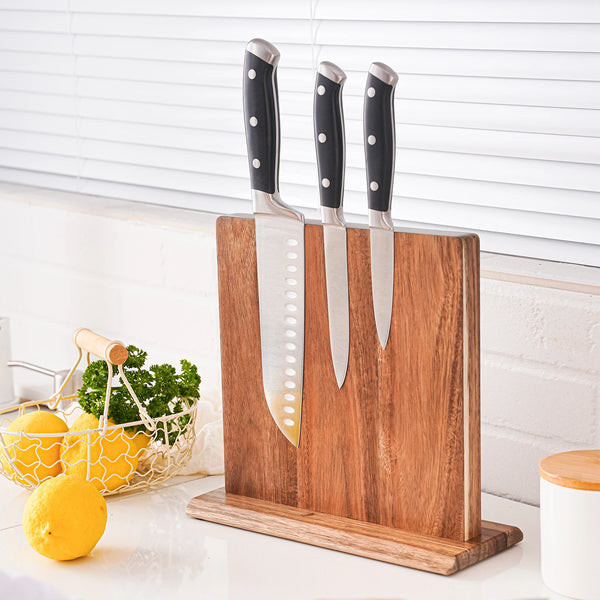
A magnetic knife block gives you the same open, slot free storage on the worktop. The Seki acacia magnetic knife block is an upright slab of acacia wood on a wide base, with magnets hidden inside both faces, so it takes a full set without crowding and has no slots to trap crumbs or water. It stands 25 cm high on a footprint of 23.5 x 10 cm and weighs about 1.35 kg. Put knives on and take them off just as you would on a wall strip, with the whole blade flat against the wood.
Keeping knives and strip in good order
Put knives back clean and dry, and wipe the strip now and then. A wooden board is the other half of keeping an edge sharp, so see our guide to caring for a wooden chopping board. For more ways to clear the worktop, read storage that does not look like storage, or browse kitchen and dining and storage and organisation.
Questions
Do magnetic knife strips damage knives?
Not if you use them properly. Touch the spine to the strip first and roll the blade flat, then take it off by rolling the edge away. A wooden faced strip is the gentlest on blades.
How high should a magnetic knife strip be?
High enough that the tip of your longest knife clears the worktop and any appliances by a few centimetres, which usually puts it in the gap below the wall cupboards. The handles should be easy to reach without leaning over the hob.
Can you put a magnetic knife strip on plasterboard?
Yes. Screw into a timber stud behind the board, or use hollow wall anchors made for plasterboard. Ordinary plastic plugs alone are not secure enough.
Are magnetic knife strips safe with children?
A strip keeps knives out of drawers that small children can open, but the blades are on show. Fit it well above their reach and away from the edge of the worktop, or fix it inside a high cupboard door.
The pieces in this guide
Everything named above, with the price on it. Free delivery, tracked to your door, and the delivery window stated before you pay.