Guide
Small hallway storage ideas: coat stands, wall hooks and shoe racks
In a small hallway, storage has to go up the walls and stay shallow. Use wall hooks or a hook rail for coats, a narrow shoe rack or slim cabinet for shoes, one shallow shelf for keys and post, and set a firm limit on how much lives by the front door. Floor standing pieces should be saved for corners and the end of the hall, where they do not narrow the walkway. Here is how to plan it for a typical narrow UK hallway.
Measure what you can actually use
Many UK hallways, particularly in terraced houses and newer homes, are not much more than a metre wide, and they also have to fit a radiator, a front door that swings inwards, light switches, the bottom of the stairs and sometimes a meter cupboard. Before you buy anything, measure the width of the hall, mark the arc of the front door as it opens, and note where the radiator and switches are.
Then think about projection, meaning how far anything sticks out from the wall. In a hall around a metre wide, anything deeper than about 30 cm on one side starts to make the walkway feel tight, especially with a pushchair, shopping bags or two people passing. Wall hooks and shallow shelves project only a few centimetres, which is why they do most of the work in small hallways.
Decide what really needs to live by the door
Most hallway clutter is a question of quantity, not storage. A good starting rule is one hook per person plus one spare for guests, and two pairs of shoes per person at the door. Everything else, such as the second winter coat, the walking boots and the summer sandals, goes somewhere else: under the stairs, in a bedroom wardrobe or in a box in the loft. Swap them over when the season changes.
Wall hooks: the most storage for no floor space
Hooks are the most efficient storage in a narrow hall because they use none of the floor. For adults, fix them roughly 160 to 170 cm from the floor so long coats hang clear of the skirting. If you have children, add a second, lower row at about 100 to 120 cm so they can hang their own coats and bags.
A hook rail keeps several hooks neat and evenly spaced. The Hida flip hook coat rack has eight wooden slats side by side; tip one forward and it flips down into a hook, push it back and it folds flat. With every hook closed it reads as a piece of wall sculpture rather than a coat rack, which helps in a hallway you can see from the living room. It is 45.5 cm wide and comes with wall plugs and screws, plus adhesive pads for a no drill option. For heavy winter coats, the screws are the safer choice.
Single hooks are useful where a rail will not fit, such as beside a door frame or at the end of a run of wall. The Yakushima branch wall hook is cut from a real forked branch of solid wood, smoothed by hand, and no two are the same. A row of three at slightly different heights takes keys, a bag and a hat, and looks gathered rather than bought.
A shelf and hooks in one
Every hallway needs one small surface for keys, sunglasses and the post. In a narrow hall, a deep console table may not fit, but a shallow wall shelf will. The Magome curved wall shelf combines both jobs: a narrow ledge on top, 7.2 cm deep, with five hooks underneath that fold down one at a time when you need them and fold away when you do not. At 52.7 cm long it fits the strip of wall beside a front door. It needs drilling into the wall.
Put a small bowl on the ledge for keys and make it the only place keys go. It is a simple habit that saves a lot of searching. If you do have room for a console table, our guide to what to put on a console table covers how to keep it useful without letting it fill up.
When a coat stand makes sense
A freestanding coat stand is the right answer in two situations: when the walls are taken up by doors, a radiator or switches, and when you rent and cannot drill. Put it in a corner or at the far end of the hall, not halfway along the walkway.
Check the footprint, not just the height. The Shinano wooden coat stand is a single slim trunk of solid wood with eight angled pegs, and its flat round base is 37 cm across, which tucks neatly into a corner. Its trunk comes in sections, so it can be built to 72, 122 or 172 cm tall on the round base, and a lower stand works well for a child's coats. There is also a three legged tripod base, which reaches about 175 cm; splayed legs take up more floor, so the round base is the better fit for a tight corner.
Shoes: go narrow, and go up
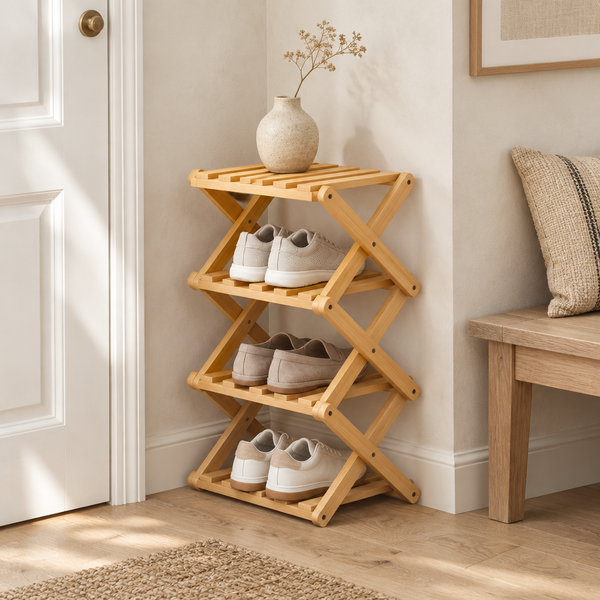
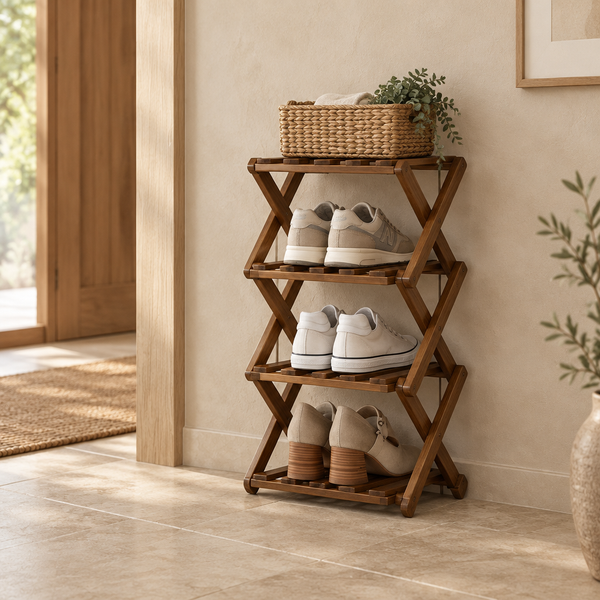
Shoes take up the most floor in any hallway, and the answer is to stack them vertically on a narrow footprint rather than lining them up along the skirting board. Slatted shelves are better than solid ones for shoes, because air can circulate around anything that comes in wet.
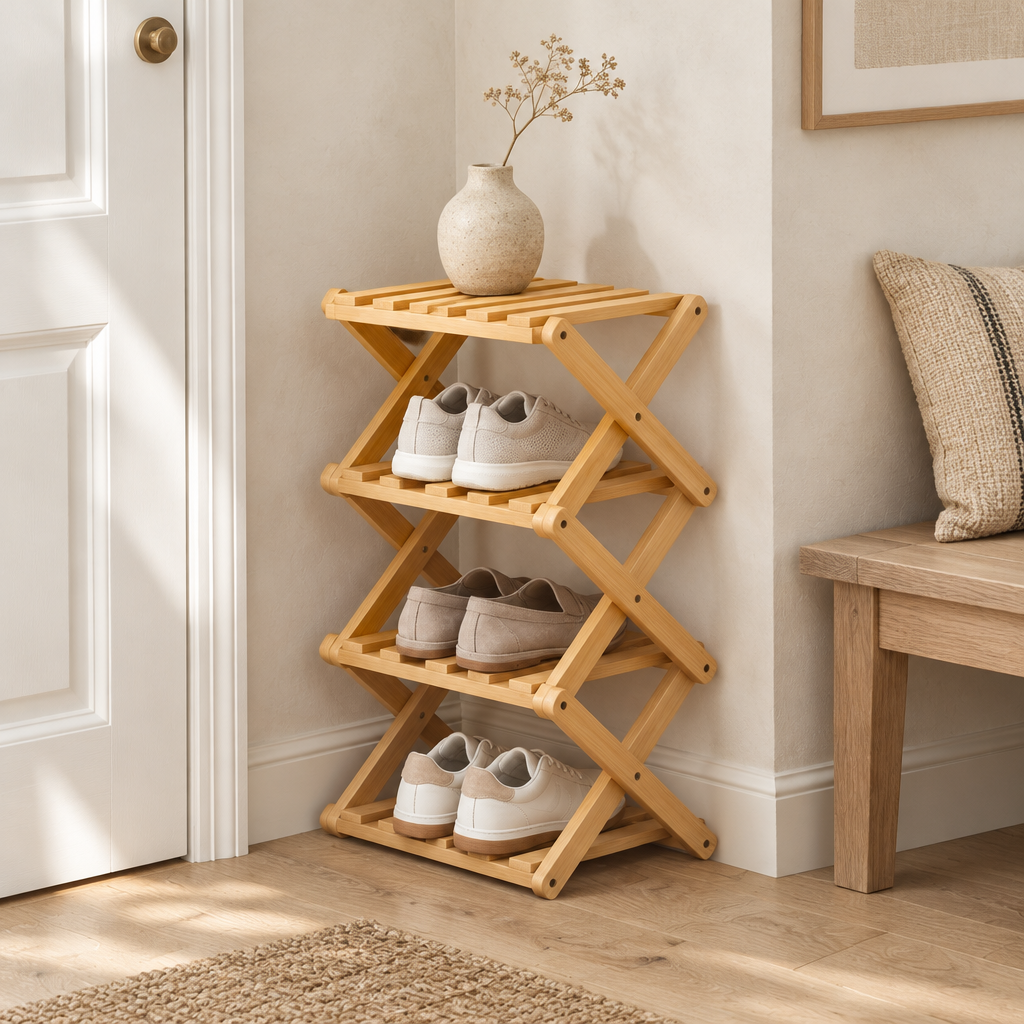
The Sakata folding bamboo shoe rack takes up a footprint of just 26 x 26 cm, so it fits beside a front door or into the gap at the end of a hallway. It comes with three, four or five slatted tiers, at 37, 54 or 75 cm tall, opens out with nothing to assemble and folds flat when you need the space.
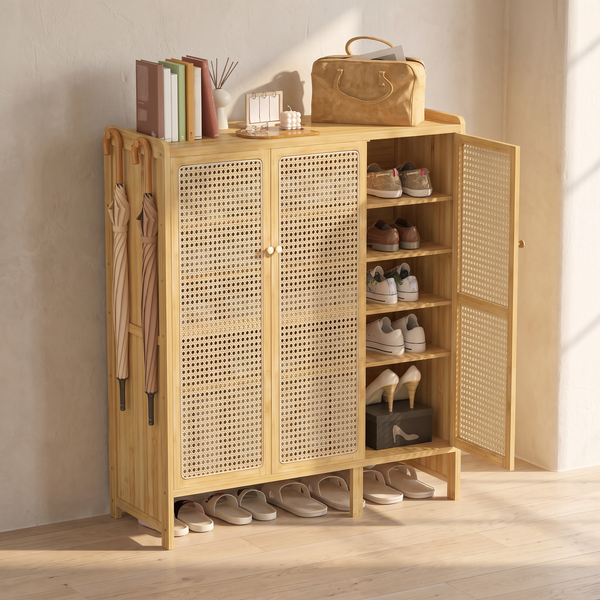
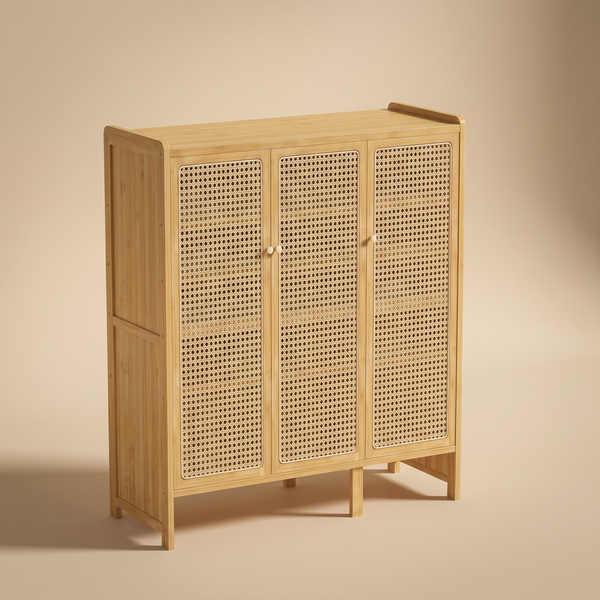
If you would rather have shoes out of sight and the hallway is a little wider, a slim cabinet hides everything behind doors. The Hakone bamboo cane cabinet is 35 cm deep and 90.5 cm wide, with three doors panelled in woven cane that let air move through, and six tiers inside deep enough to stand boots upright. It is raised on legs with an open gap underneath for the pair you wear every day, and the top gives you a surface for keys and post.
On wet days, a simple boot tray just inside the door keeps mud off the floor and away from the rest of your shoes.
Use the awkward spaces
The space under the stairs is the most valuable storage in many UK houses. Even without fitted drawers, a few large lidded baskets on the floor of the cupboard will hold out of season coats, bags and sports kit. The wall above a radiator can take a shallow shelf, as long as it is fixed high enough not to block the rising heat. The inside of a cupboard door can take a couple of small hooks for a dog lead and reusable bags.
Keep it looking calm
A small hallway looks tidier when the storage is consistent. Choose one or two materials, such as natural wood and woven cane, and keep the wood tones close to each other. Leave at least one stretch of wall completely bare, and hang a mirror if you can, to bounce light around a dark space. Lighting matters too: our guide on how to light a hallway or stairwell covers fittings that do not eat into headroom.
You can see our full range of hooks, racks and baskets in the storage and organisation collection.
The pieces in this guide
Everything named above, with the price on it. Free delivery, tracked to your door, and the delivery window stated before you pay.