Bedding
Bedspread vs quilt vs coverlet: what is the difference?

A bedspread is a large top cover that hangs down close to the floor on both sides of the bed, a quilt is three layers of fabric and padding stitched together, and a coverlet is a lighter, smaller top layer that covers the mattress and drops only part of the way down the sides. In practice the words overlap, and the light quilted covers most people buy today sit somewhere between all three. Here is how to tell them apart, what size to buy for a UK bed, and how to layer them through winter and summer.
What is a bedspread?
A bedspread is the largest of the three. Traditionally it is a single decorative cover that goes over everything, sometimes including the pillows, and falls almost to the floor on both sides and at the foot, hiding the mattress and the base.
Bedspreads are usually fairly light, because their job is to make the bed look tidy during the day rather than to keep you warm at night. They can be woven, quilted or tufted, and many people fold them back at night or take them off altogether.
What is a quilt?
A quilt is defined by how it is made: a top fabric, a layer of wadding and a backing fabric, all stitched through together. The stitching holds the three layers in place and makes the pattern you see on the surface, such as channels, diamonds or patchwork.
A quilt can be any size and is usually thinner and flatter than a duvet. In the UK the word causes confusion, because many people, particularly older generations, also call a duvet a quilt. When you see "quilted" on a bedspread or coverlet, it simply means it has been made this way.
What is a coverlet?
A coverlet is a lighter, more modest top layer. It covers the top of the mattress and drops part of the way down the sides, but not to the floor, and it usually stops short of the pillows. It may be quilted, woven or a single layer of washed fabric.
A coverlet earns its place twice a year. In summer it can be the only layer over a sheet on warm nights. In winter it goes over the duvet to tidy the bed and add a little extra warmth.
Where a duvet and a throw fit in
A duvet is the filled layer that goes inside a cover and does most of the work of keeping you warm. Its warmth is measured in tog, from around 4.5 tog for summer up to 13.5 tog or more for winter.
A throw is the smallest top layer, usually laid across the foot of the bed rather than over the whole of it. Our guide to choosing a throw covers materials and sizes in detail.
Sizes for UK beds
Start with your mattress. Standard UK mattress sizes are 90 x 190 cm for a single, 120 x 190 cm for a small double, 135 x 190 cm for a double, 150 x 200 cm for a king and 180 x 200 cm for a super king. European and American sizes differ, so check covers against your own mattress.
For a coverlet, add twice the drop you want to the width of the mattress. A drop of around 30 to 40 cm on each side covers the side of most mattresses neatly. For a bedspread that reaches the floor, measure from the floor on one side, up over the made bed and down to the floor on the other side, and do the same from the head of the mattress to the floor at the foot.
The Takasaki quilted bedspread is a lightweight stitched quilt that lies flat over a made bed, in beige, grey or sage. As a guide, the 200 x 230 cm size suits a double, 230 x 230 cm a king and 264 x 230 cm a super king, each with some overhang, so on a UK mattress that works out at a drop of roughly 30 to 40 cm each side. It works on its own on warmer nights or over a duvet in winter.
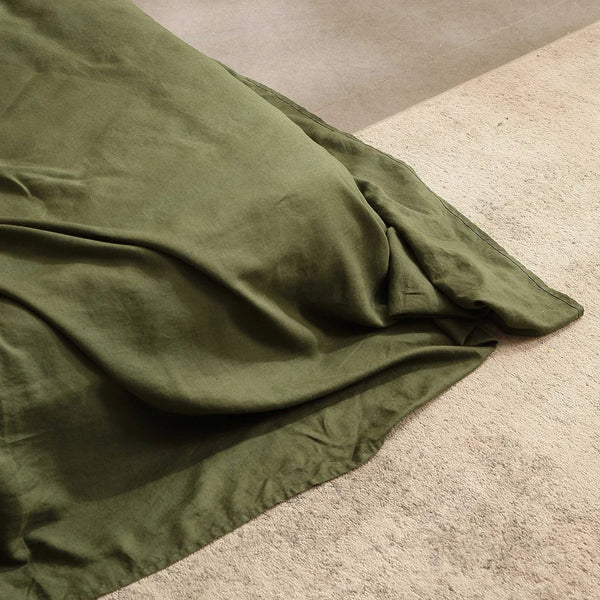
If you want something lighter still, the Hanno cotton linen bed throw is a cotton and linen blend washed to a soft crinkle, with a plain stitched hem. The 150 x 200 cm size suits the foot of a double bed, while the 200 x 220 cm size covers the top of a double or king as a light coverlet. It comes in caramel, light grey, sage, deep green and charcoal.
Layering in winter
A warm winter bed is built in layers, so you can add or remove one as the nights change. Start with a fitted sheet and a winter weight duvet in a cover, then add a blanket and finally a quilted cover on top.
The duvet cover is the largest area of colour and texture in the room. The Takasago ruched duvet cover is covered in fine gathers, so the bed has texture and depth even when it is made in a hurry, and small creases hide in the ruching. It is a soft brushed synthetic fabric in white, beige or black, in a double at 200 x 200 cm or a king at 240 x 220 cm, which is slightly larger than a standard UK king duvet and gives a little extra drop.
Over the duvet, a wool blanket is the warmest natural layer. The Hakusan wool blanket is a heavy, plain blanket with a brushed surface and a wide satin binding, in camel in 100% wool or cream in 70% wool and 30% cashmere, in 150 x 200 cm, 180 x 200 cm or 200 x 230 cm. Lay it across the bottom half of the bed, then pull the quilted bedspread over everything in the morning. At night, fold the bedspread down to the foot of the bed and pull it up if you get cold.
See also our guide to making your home cosy for winter.
Layering in summer
In summer the aim is the opposite: fewer layers, and fabrics that breathe. Many people put the duvet away altogether, or switch to a light summer tog, and sleep under a sheet with a coverlet on top.
Linen is the most comfortable fabric for warm nights. The Kiryu pure linen sheet set is washed 100% linen with a flat sheet, a fitted sheet 35 cm deep and pillowcases, in olive, caramel or white. If you keep a light duvet on the bed, the Ojiya pure linen duvet cover set is 100% washed linen at 160 gsm with a zip closure and two pillowcases, in natural, charcoal or white.
For the top layer, the Hanno throw does the job of a light quilt on warm nights. Another option is the Niseko cotton muslin blanket, six layers of open weave cotton muslin that stays light and lets air through. Its 200 x 230 cm size works as a top layer on a double bed, and the 150 x 200 cm size suits a single or the sofa.
Making the bed look finished
The easiest way to make a bed look considered is to keep the layers in two or three related colours and mix the textures: smooth or ruched on the duvet, a quilted or crinkled cover on top and a heavier blanket at the foot. Fold a coverlet back by a third at the head to show the pillows, or fold it into thirds across the foot of the bed during the day.
Our Japandi bedroom ideas have more on building a calm bed, and our guide to washing and caring for linen covers the linen layers. Browse the full range in linen bedding and throws and the bedroom collection.
Questions
What is the difference between a bedspread and a quilt?
A bedspread is defined by its size: a large top cover that reaches close to the floor. A quilt is defined by how it is made, with three layers stitched together, so a bedspread can also be a quilt.
What is a coverlet used for?
A coverlet is a light top layer that covers the mattress and drops part of the way down the sides. Use it alone over a sheet in summer, or over the duvet in winter to tidy the bed and add warmth.
What size bedspread do I need for a king size bed?
A UK king mattress is 150 x 200 cm, so a cover around 230 cm wide gives a drop of about 40 cm each side. For a bedspread that reaches the floor, measure from floor to floor over your made bed.
Can you use a coverlet instead of a duvet?
Yes, on warm nights. A coverlet over a sheet is cooler than even a summer duvet, and you can add a blanket at the foot of the bed for cooler evenings.
The pieces in this guide
Everything named above, with the price on it. Free delivery, tracked to your door, and the delivery window stated before you pay.