Cosy home
How to make your home cosy for winter

To make your home cosy, turn the light down and make it warmer, then add soft things you can touch: a throw on the sofa, a rug underfoot, heavier curtains and a few candles. Most of the effect comes from lighting, so start there, and use texture rather than colour to make the room feel warm through the long UK winter.
Start with the lighting
A single bright ceiling light is the fastest way to make a room feel cold. It flattens the room and casts shadows under everyone's eyes. In the evening, switch it off and light the room from lower down instead, with three or four smaller sources at different heights: a floor lamp in a corner, a table lamp beside the sofa, something on a shelf or sideboard.
Colour temperature matters as much as brightness. Bulbs around 2700K give the warm, slightly golden light that reads as cosy; anything above 4000K starts to feel like an office. Our guide to warm, neutral and cool light explains the numbers if you are replacing bulbs.
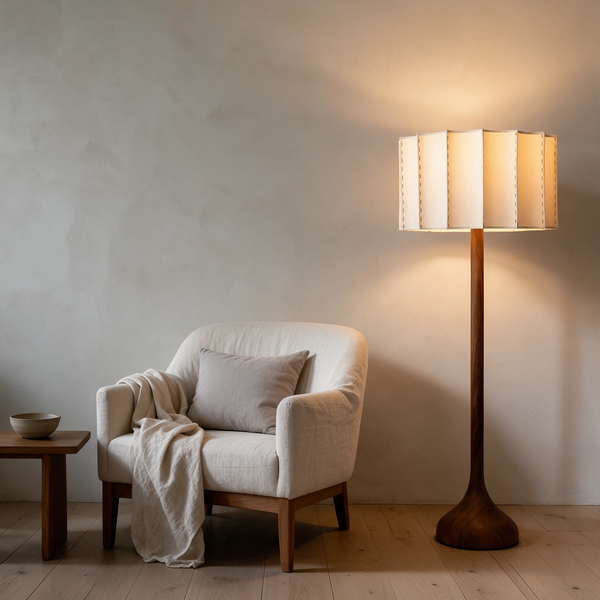
Shades that diffuse the light help too. Fabric and paper soften the bulb so the lamp glows rather than glares. The Yanagawa scalloped shade lamp has a turned wood stem and a white fabric shade folded into deep scallops, which glow in bands of light and shadow when it is lit. It comes as a table lamp for a sideboard or bedside, or as a floor lamp to stand beside an armchair.
For a corner that needs height without taking up floor space, the Asama tripod floor lamp is a slim white fabric column, 128 cm tall, on three solid wood legs in natural wood or walnut. The whole column lights up evenly, so it fills a dark corner with soft light. On a bedside table, the Gifu rice paper lamp does a similar job at a smaller scale, and its included bulb switches between warm, neutral and cool white, so you can keep it on warm in the evening.
Lamps without a socket nearby
Many UK living rooms have sockets in all the wrong places. A cordless lamp solves this for a dining table, a windowsill or a shelf. The Hodaka cordless table lamp charges up and then runs without a cable, with a touch switch and a warm 2700K bulb under a pleated or drum fabric shade. Move it to the dinner table at seven and to the bedside at eleven. Our guide to rechargeable wall lights covers wire free wall lights too.
Add a throw you will actually use
A throw is the simplest way to add warmth to a sofa, and the best ones are kept where you can reach them, folded over an arm or across the seat, rather than arranged for show. Choose by how you use the room.
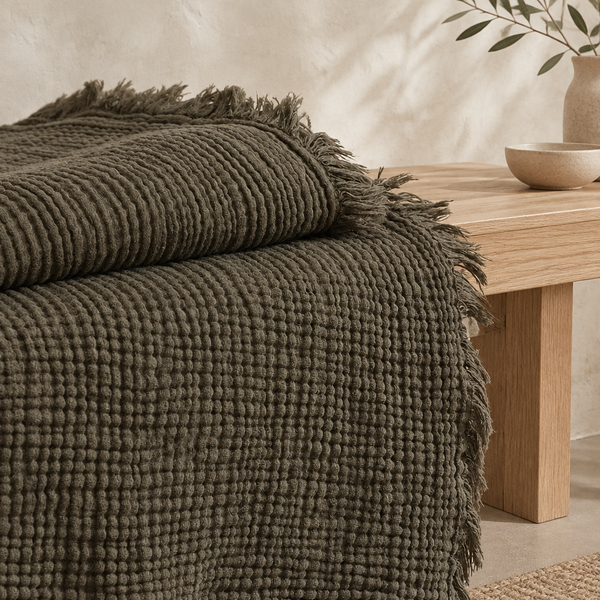
For a light, everyday throw, the Shimabara cotton gauze throw is four layers of 100% cotton gauze stitched together so they pucker into a soft crinkle. It is warm enough for an evening on the sofa without being stuffy, it is machine washable and it does not need ironing. For real winter warmth, the Hokuto faux fur throw is a thick double layer blanket with a long, dense pile in soft ribs, in cream, camel, taupe or grey. To cover a whole sofa, the Kibi chenille throw comes 180 cm wide in lengths up to 300 cm, with a herringbone weave and a non slip finish on the back to help it stay put.
If you are deciding between materials and sizes, our guide on how to choose a throw goes through the options.
Put something soft underfoot
Bare floorboards and laminate look good in summer and feel cold in January. A rug warms the room visually and physically, and it softens the sound of a room with hard floors.
Size matters more than pattern. In a living room, the rug should be large enough for at least the front legs of the sofa and chairs to sit on it, which in most UK living rooms means 160 x 230 cm or larger. A small rug floating in the middle of the floor makes the room look smaller.
The Shirakawa braided wool rug is made from cords of braided wool, hooked by hand and laid in rectangles one inside the next, in oatmeal, cream or light grey. Wool feels warm and dry underfoot and has a natural, matte texture. For something softer and plusher, the Ikoma plush rug has a short, dense cream pile with tonal streaks in warm sand or cooler stone.
Change the curtains for winter
Light summer curtains or sheers let the evening in at four o'clock. A heavier curtain closes the room off at dusk, keeps some of the draught from the window away from the sofa, and adds another soft texture.
Hang the pole higher and wider than the window so the curtains sit against the wall when open, and choose a length that just touches or sits just above the floor. If there is a radiator under the window, do not let long curtains hang over it when closed, or the heat goes behind them and up the glass. Tie them back, or choose a length that stops above the radiator.
The Kirigaoka chenille curtain is a thick chenille in a fine herringbone weave that hangs in deep, even folds. It softens daylight rather than blacking it out, so it works on its own or layered over a sheer. Each panel is 250 cm long in three widths, with a rod pocket or eyelet heading, and most windows need two.
Candles, and where to put them
Candlelight is the warmest light there is, at around 1800K, and a few flames do more for a room than another lamp. Group them rather than scattering them: two or three tapers together on a mantelpiece or dining table look deliberate, while single tealights dotted about look like a power cut.
The Tivoli travertine candle holder is a single block of unpolished travertine drilled for two standard taper candles, heavy enough to stay where it is put, with felt pads underneath. Nagasaki taper candles are unscented, so they sit happily on the dinner table without competing with the food. Never leave a lit candle unattended, and keep flames well away from curtains and throws.
Layer textures, not colours
A cosy room does not need red and tartan. In a calm, neutral room, warmth comes from texture: the slub of linen, the loops of a knitted throw, the nap of chenille, the grain of wood. Put three or four different textures next to each other on the sofa and the room feels warmer without any change of colour.
Cushions are the easiest place to start. The Akiyoshi chenille cushion covers are woven from a coarse, slubbed chenille yarn in plain camel, cream, coffee, charcoal or moss, sold as a pair, covers only. Put them next to linen, add a knitted or gauze throw, and the sofa has three textures in one go.
Warm neutrals help too: oatmeal, camel, caramel, rust and moss feel warmer under lamplight than cool greys and bright white. Our guide to Japandi living room ideas covers palettes that suit grey UK daylight.
Small things that make a difference
A few quick changes do most of the work this weekend:
- Swap any cool white bulbs in the living room for warm white
- Switch off the ceiling light after dark and use lamps
- Put a throw where you sit, not where it looks best
- Draw the curtains at dusk to close the room off
- Light two or three candles together at dinner
You will find all of our winter pieces, from lamps and throws to rugs and curtains, in the Cosy Season collection.
Frequently asked questions
How can I make my house cosy on a budget?
Change the light first: swap cool bulbs for warm white ones and use a couple of lamps instead of the ceiling light. Then add one throw and a few candles. Those changes cost little and make the biggest difference to how a room feels in the evening.
What colour light bulb is the most cosy?
Warm white bulbs, around 2700K, give the soft golden light most people find cosy. For the evening you can go lower, to around 2200K, which is close to candlelight.
How do I make a cold room feel warmer?
Cover hard floors with a rug, hang heavier curtains and close them at dusk, and keep curtains off radiators so the heat comes into the room. Warm textures such as wool, chenille and knitted cotton make a room feel warmer too, even before the heating comes on.
Which rooms should I make cosy first?
Start with the room you spend your evenings in, usually the living room, and then the bedroom. Those are the rooms where low, warm light and soft textures change how you feel at the end of the day.
The pieces in this guide
Everything named above, with the price on it. Free delivery, tracked to your door, and the delivery window stated before you pay.