Guide
How to style open shelves: shelf styling ideas for kitchens and living rooms

To style open shelves, clear them completely, then put back only the things you use or love, in small groups of three or five with a mix of heights, and leave about a third of every shelf empty. Books, a few ceramics and one or two baskets for the clutter are enough for most shelves. Here is how to apply that to an open kitchen shelf and to a living room bookcase or alcove.
Start with an empty shelf
Take everything off, wipe the shelf down, and sort what you removed into three piles: things you use every week, things you genuinely like to look at, and everything else. The third pile goes into a cupboard, a drawer or a lidded box. Our guide to storage that does not look like storage has ideas for where.
Then give each shelf a job. In a kitchen that might be one shelf for everyday cups and bowls and one for the jars you cook from. In a living room it might be books on most shelves with a few objects between them.
Group in threes and fives
Odd numbers look relaxed; pairs look formal, which suits a mantelpiece but can look stiff on a shelf. Put objects together in groups of three, or five on a long shelf, so they read as one arrangement rather than a row of separate things.
Within each group, think of a loose triangle: one taller piece towards the back or one side, a medium piece next to it, and something small or low in front. Let the pieces nearly touch.
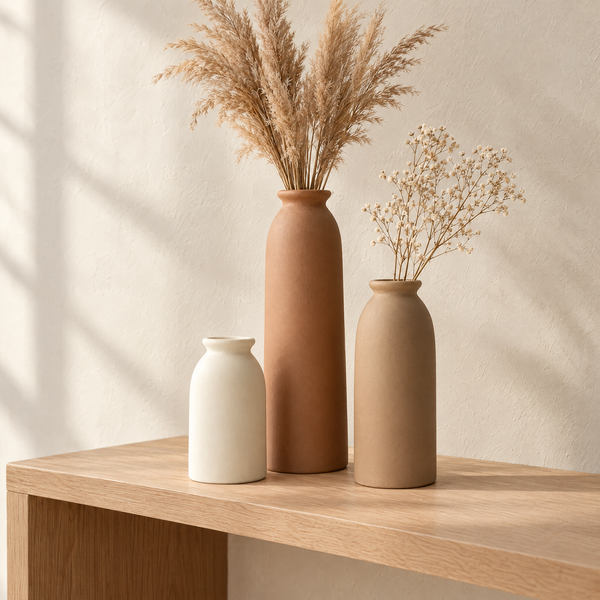
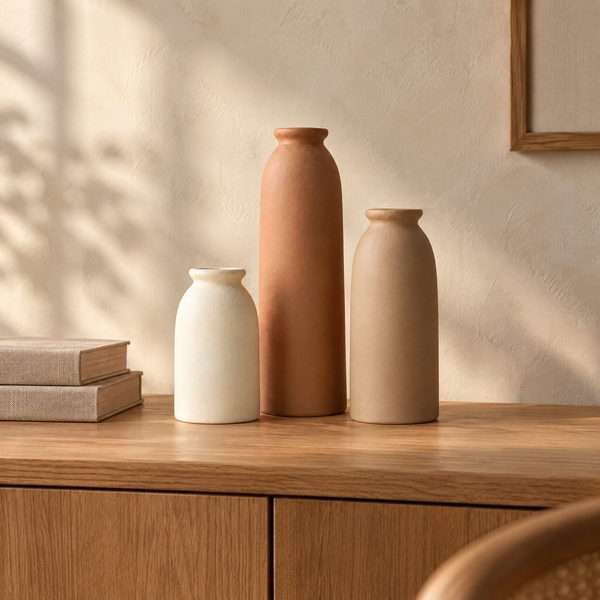
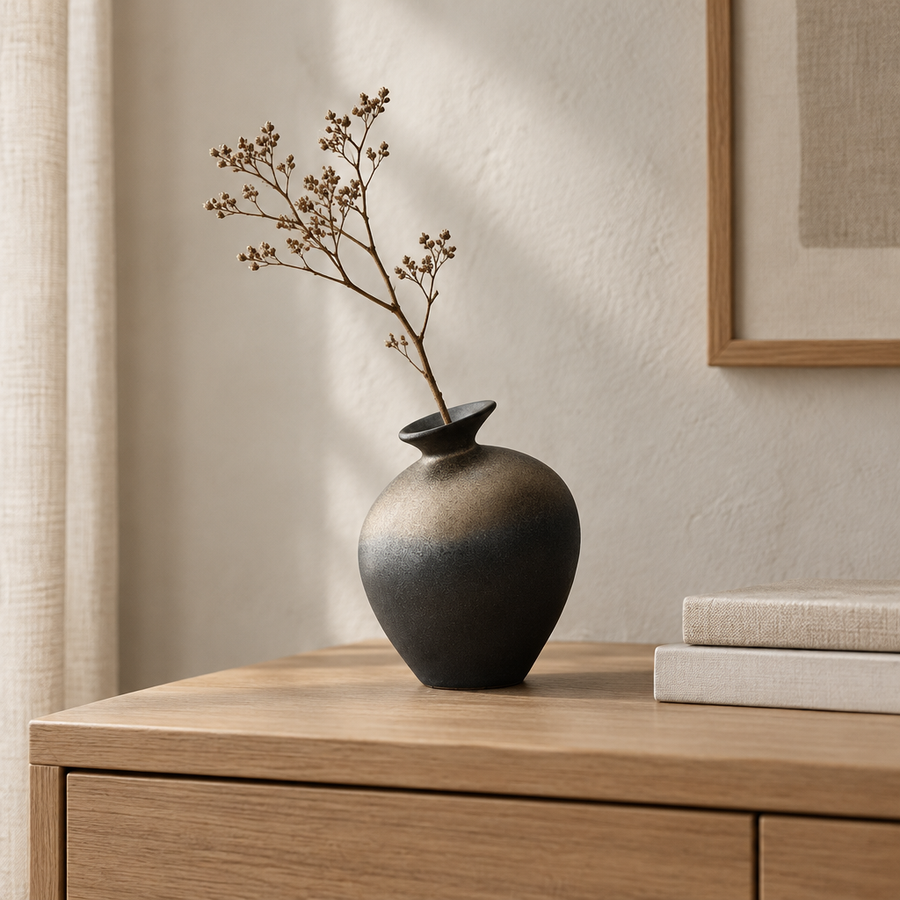
Vases sold singly make this easy. The Chino matte ceramic bottle vases come in five shapes in white or charcoal, from a round bud 17 cm tall to a slender neck 46 cm tall, so you can build a group of three in two tones. The Tamba bottle vases come as a ready made set of three in cream, sand and clay, stepping up from about 12.5 cm to 26.6 cm tall, with a dry matte finish closer to unglazed clay than shiny pottery.
Vary the height, and zigzag across the unit
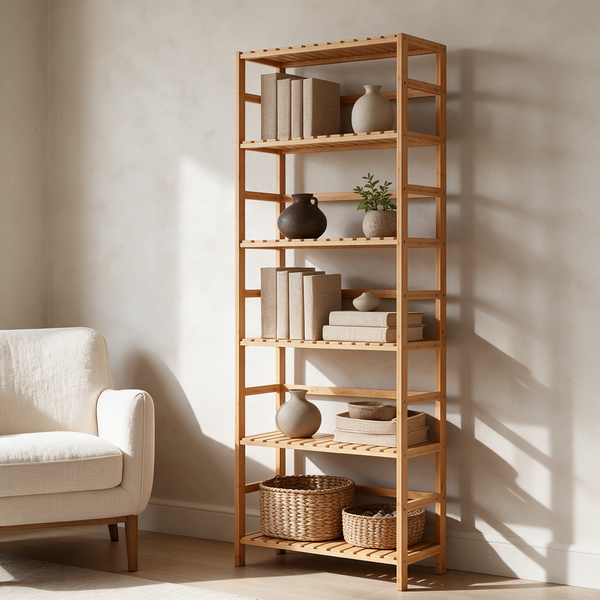
Mix tall and low within each shelf, then look at the whole unit: if the tallest thing on the top shelf sits on the left, put the tallest thing on the shelf below towards the right. The eye then moves across the shelves in a gentle zigzag rather than straight down one side.
Keep the heaviest looking things, such as baskets, big books and solid ceramics, on the lower shelves, and lighter, paler pieces higher up, or the unit will look top heavy.
If you are starting from scratch, a freestanding unit with adjustable shelves lets you set the heights around what you own. The Ojika bamboo shelving unit is 60 cm wide, 26 cm deep and 161 cm tall, with six slatted bamboo shelves on four slim posts that can be set at different heights, so a tall vase gets the space it needs. An anti tip strap is supplied for fixing it to the wall.
Leave negative space
Empty space is what makes the things on a shelf look chosen. As a rule, leave around a third of each shelf clear, and let at least one shelf in a unit hold very little: a single vase, or one short stack of books. On a narrow wall shelf, one object is often enough.
Books: stand some, stack some
Books are what make shelves look lived in, so do not hide them. Mix upright rows with horizontal stacks of three to five books. A low stack breaks up a long row, and it doubles as a small plinth for a candle or a bud vase.
Group books by size rather than by colour; a rainbow of spines can look busier than a natural mix.
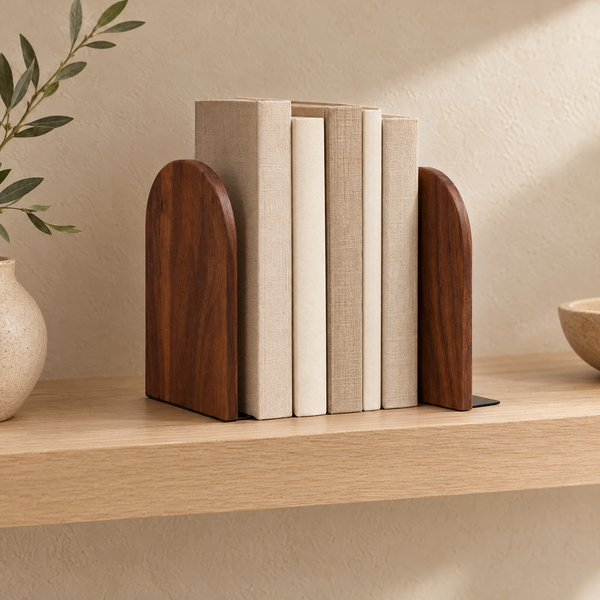
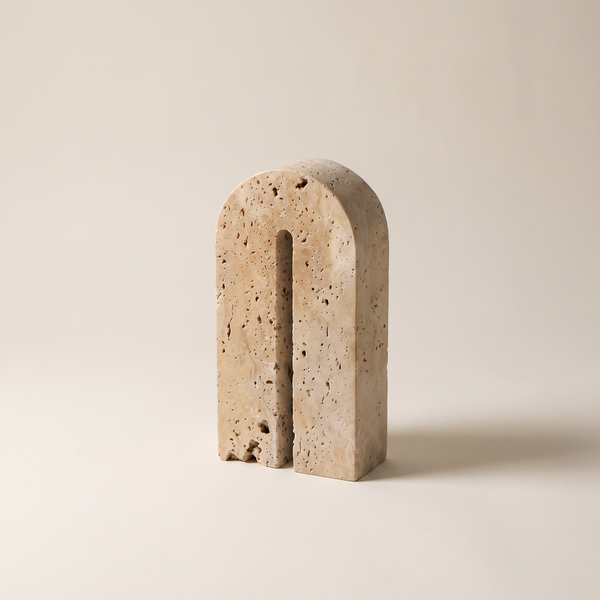
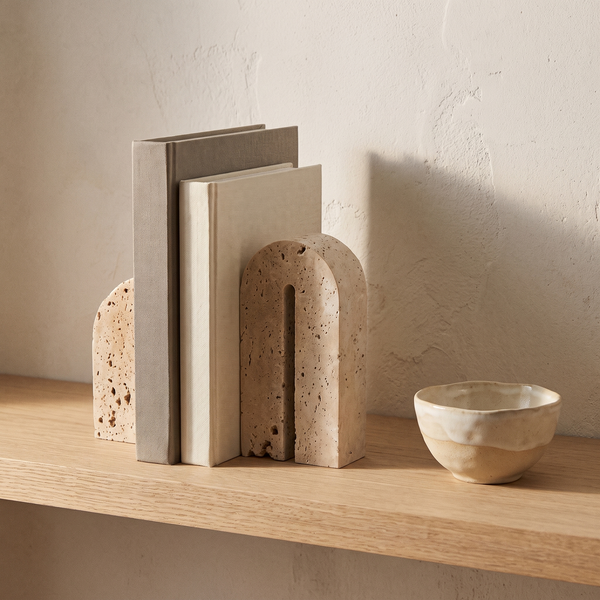
Upright rows need bookends unless they fill the shelf. The Sado arched wooden bookends are a pair of plain wooden panels with a rounded top, in walnut or beech, each on a thin dark metal plate that slides under the first book. The small 13 cm size suits paperbacks and the large 17 cm size holds hardbacks. To show one book face out, such as a favourite cookbook or a book of photographs, the Milan travertine book holder is carved stone with a vertical slot that holds a book upright, in a small 12.5 cm or large 20 cm size.
Ceramics and vases
Handmade or textured pieces give a shelf its character. Choose a narrow range of colours and repeat them from shelf to shelf, so a charcoal vase on the top shelf is answered by something dark on a lower one.
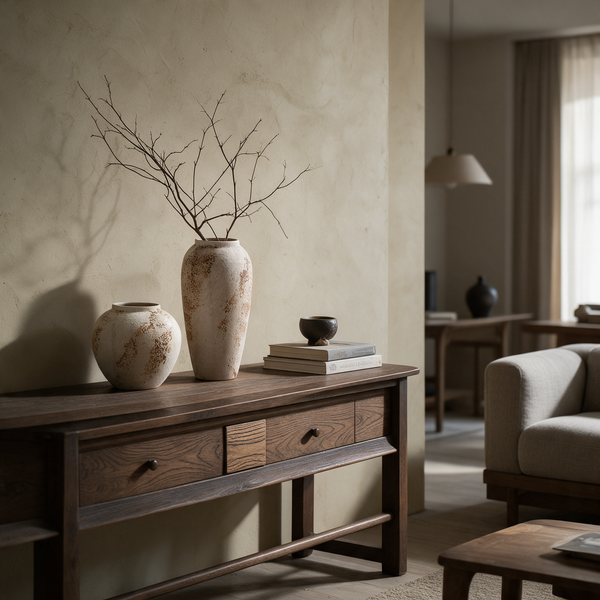
The Onta weathered stoneware vase has a rough, sandy glaze in chalky off white broken by patches of rust brown, in three shapes from a 20 cm round jar to a 34 cm tall vase. For smaller gaps, the Shino stoneware bud vases are made to hold one stem, as low pebbles about 7 cm tall or rounded jars about 14 cm tall.
Baskets and boxes for the bottom shelf
Baskets on the lower shelves hide chargers, paperwork and spare candles, and add warm texture at the same time.
The Hita rattan storage basket is an open, straight sided tray basket woven by hand, in five sizes from 20 x 14 x 7 cm to 36 x 26.5 x 13 cm, so you can choose a size that fits your shelf depth. For things you want completely out of sight, Omi seagrass storage boxes are lidded and close with a cord loop and toggle, sold as a stacking set of three or four. Keep seagrass away from damp, so not right beside the kettle or the sink.
Styling open kitchen shelves
Kitchen shelves work best holding things you use often, because pieces washed every day never gather the film of dust and grease that settles on things left untouched. Stack plates and bowls in neat piles of the same kind, and line cups up in a single row.
Decanting dry food into matching jars turns a shelf of packets into something calm. Otaki glass pantry jars are a set of four clear jars of about 470 ml each, with bamboo lids that seal with a silicone ring. For tea, coffee or sugar left out by the kettle, the Kanuma stoneware tea caddy has a snug lid and a loop handle, short or tall, in speckled ochre or matte black, and a handmade Hagi ceramic storage jar comes in three glazes and three sizes from about 450 ml to about 2200 ml.
Beside the hob, where a deep shelf would get in the way, the Onomichi wall shelf is only 11.5 cm deep: a black metal tray with a dark wood rail along the front that stops bottles of oil and jars of spices slipping off. It comes in 40, 50 or 60 cm lengths.
Styling living room shelves and alcoves
In a living room with alcoves on either side of a chimney breast, style both sides with the same mix of books, objects and baskets, but not the same objects in the same places. A small lamp on a middle shelf adds a warm glow in the evening. For more on dressing the room, see our Japandi living room ideas, and for a narrower surface, what to put on a console table.
A quick checklist
- Clear everything off and put back only what you use or love
- Group objects in threes or fives, with a mix of heights
- Zigzag the tallest pieces from shelf to shelf
- Keep heavy things low and light things high
- Leave about a third of each shelf empty
- Hide the clutter in baskets on the bottom shelf
You can find more in vases and ceramics and storage and organisation.
Questions
How many things should go on a shelf?
Fewer than you think. One or two groups of three objects on a typical 60 to 90 cm shelf, plus books, is usually plenty. If you can still see about a third of the shelf, you have the balance right.
How do you style shelves without them looking cluttered?
Group things rather than spacing them out evenly, repeat a small number of colours and materials, and leave clear space between the groups. Anything you cannot group goes in a basket or a cupboard.
What do you put on open kitchen shelves?
Things you use every day, such as cups, bowls and the jars you cook from, plus one or two objects you like to look at. Everyday pieces stay clean because they are washed often.
How do you stop open shelves getting dusty?
Keep fewer things on them and use what is there regularly. Dust the shelves weekly with a dry or slightly damp cloth, and wipe any shelf near the hob more often, as grease settles there first.
The pieces in this guide
Everything named above, with the price on it. Free delivery, tracked to your door, and the delivery window stated before you pay.