Glassware
What is borosilicate glass, and is it safe?

Borosilicate glass is glass made with boron trioxide added to the silica, which means it expands far less as it heats up, so it copes with hot drinks and sudden changes of temperature much better than ordinary glass. It is also safe for food and drink: it is non porous, it does not react with what you put in it and it contains no plastics or coatings. Here is what that means in everyday use, how it differs from the soda lime glass most glassware is made from, and how to look after it.
What borosilicate glass is made of
All glass starts with silica, which is essentially very pure sand. Ordinary glass, called soda lime glass, adds soda ash and lime so the silica melts at a lower temperature and is cheaper to work. It is what most windows, jam jars, bottles and everyday drinking glasses are made from.
Borosilicate glass replaces much of the soda and lime with boron trioxide. A typical recipe is around 80% silica and 13% boron trioxide, with small amounts of other oxides. The German glass chemist Otto Schott developed it in the late nineteenth century for laboratory glass and thermometers, and it is still the standard material for beakers and test tubes.
On product pages you will often see the words "high borosilicate". It describes the same family of glass with a relatively high boron content, sometimes called borosilicate 3.3 after its expansion figure, which is explained below.
Heat resistance in plain terms
Glass does not crack because it gets hot. It cracks because one part gets hot faster than another. Pour boiling water into a cold glass and the inside surface warms and expands while the outside is still cold. That difference puts the glass under strain, and ordinary glass can crack.
Borosilicate glass expands about a third as much as soda lime glass for the same rise in temperature. Its expansion figure is around 3.3 millionths of its size per degree, against roughly 9 for soda lime glass, which is where the 3.3 name comes from. Less expansion means much less strain, so it takes boiling water, a hot dishwasher or a cold drink poured into a warm glass far more calmly.
Resistant is not the same as indestructible. A very sudden extreme, such as cold water poured into glass that has been sitting on a hot hob, or a hot carafe set down on a wet stone worktop, can still crack it. Scratches and chips weaken any glass, so a damaged piece is more likely to fail when it is heated.
Borosilicate versus soda lime glass
For everyday use, the main differences are these. Borosilicate copes far better with heat and with changes in temperature. It is usually lighter for its strength, so pieces can be thinner and finer. It is more resistant to chemicals, which is why laboratories rely on it, and it is less prone to the cloudy etching that dishwashers can leave on ordinary glass over the years.
Soda lime glass is cheaper, easier to press into heavy, decorative shapes and perfectly good for cold drinks, vases and storage jars. Toughened soda lime glass is also strong against knocks. The difference matters most where glass meets heat: teapots, coffee makers, cups for hot drinks and ovenware.
You cannot reliably tell the two apart by eye, and a familiar brand name is no guide either, because some glass ovenware is made from toughened soda lime glass rather than borosilicate. Check the product details.
Is borosilicate glass safe?
Yes. Glass is one of the most inert materials you can keep food and drink in. Borosilicate does not absorb flavours or smells, it does not react with acidic drinks such as fruit tea, coffee or water with lemon, and it contains no plastics, so there is no BPA to think about. Laboratories use it precisely because it does not interfere with what is inside.
The sensible safety question is about breakage, and the answer is to treat it as glass. Check pieces for chips and cracks, retire anything damaged, and avoid extreme jumps in temperature. If you own double walled glass, you may notice a tiny sealed opening under the base. That is part of how double walled glass is made and is quite normal.
How to look after borosilicate glass
Follow the care advice for each piece first, because lids, wooden parts and metal filters change the rules. As a general guide, wash borosilicate in warm soapy water with a soft sponge, since abrasive pads leave fine scratches. If a piece is listed as dishwasher safe, put it on the top rack where it will not knock against pans.
For tea and coffee stains, soak the glass in warm water with a spoonful of bicarbonate of soda, then rinse. Let hot glass cool before it goes into cold water, and stand it on a cloth or a wooden board rather than cold, wet stone.
When a piece does finally break, keep it out of the household glass recycling and the bottle bank. Heat resistant glass melts at a different temperature from bottles and jars and can spoil a batch, so most UK councils ask for it to go in general waste. Check your council's own guidance.
Where borosilicate glass is used in the kitchen and at the table
Borosilicate is the natural choice anywhere glass meets heat, and it is also used for drinking glasses and carafes where you want something light and clear. These are the pieces in our range that are made from it.
For coffee, the Iyo glass pour over coffee set is clear borosilicate glass for both the ribbed dripper and the server, which holds around 600 ml, with a pale wooden collar in between. The maker lists the glass as dishwasher safe, while the wooden collar should be wiped by hand. Our guide to making pour over coffee shows how to use it.
The Tagajo double wall glass cafetiere has a borosilicate jug and glass handle with a second outer wall, so the coffee keeps its heat and the outside stays cooler to hold. It comes in 350 ml, 650 ml and 1000 ml, with a stainless steel lid, plunger and filter, and is best washed by hand.
Double walled glass shows off what borosilicate can do. The Tsugaru double wall glass cups are two walls of borosilicate with a layer of air between them, so a hot coffee stays hot while the outside stays comfortable, and a cold drink does not mist the outside or leave a ring on the table. Choose four or six 80 ml glasses for espresso, or a pair of 250 ml, 350 ml or 450 ml glasses. They are hand blown, microwave safe for up to two minutes at 600 W and freezer safe, and hand washing is recommended.
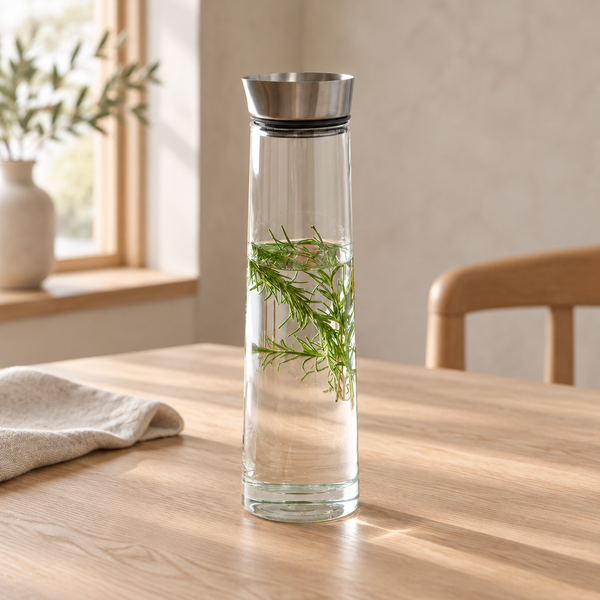
For cold drinks, the Miki wavy glass cups are high borosilicate glass shaped into soft ripples, about 300 ml each, sold as four glasses with two straight and two bent glass straws and a brush to clean them. The Iwanuma glass water carafe is a straight cylinder of clear borosilicate with a slim metal lid, in 1 litre or 1.5 litres, narrow enough to stand in a fridge door. It is meant for cold and warm drinks rather than boiling water, and should be washed by hand, which is a useful reminder that the glass is only part of the story: always check how each piece is meant to be used.
You can find more in kitchen and dining and tea and tableware, and for laying it all out, see our ideas for a calm, natural table.
Questions
Is borosilicate glass safe to drink from?
Yes. It is non porous and inert, so it does not absorb flavours or react with hot, cold or acidic drinks. It contains no plastic and no BPA.
Can borosilicate glass go in the dishwasher?
The glass itself copes well with a dishwasher, but lids, wooden parts, metal filters and some double walled pieces may not. Check the care advice for each piece, and wash by hand when in doubt.
Can you pour boiling water into borosilicate glass?
Borosilicate handles boiling water far better than ordinary glass, which is why it is used for teapots and coffee makers. Some pieces, such as carafes made for cold drinks, are not intended for it, so follow the guidance for the piece you have.
Is borosilicate glass the same as Pyrex?
Pyrex is a brand name rather than a type of glass. The original Pyrex was borosilicate, but some glass ovenware sold under the name today is toughened soda lime glass, so check the label rather than relying on the name.
The pieces in this guide
Everything named above, with the price on it. Free delivery, tracked to your door, and the delivery window stated before you pay.