Guide
Rug size guide: what size rug for a living room, bedroom or dining room
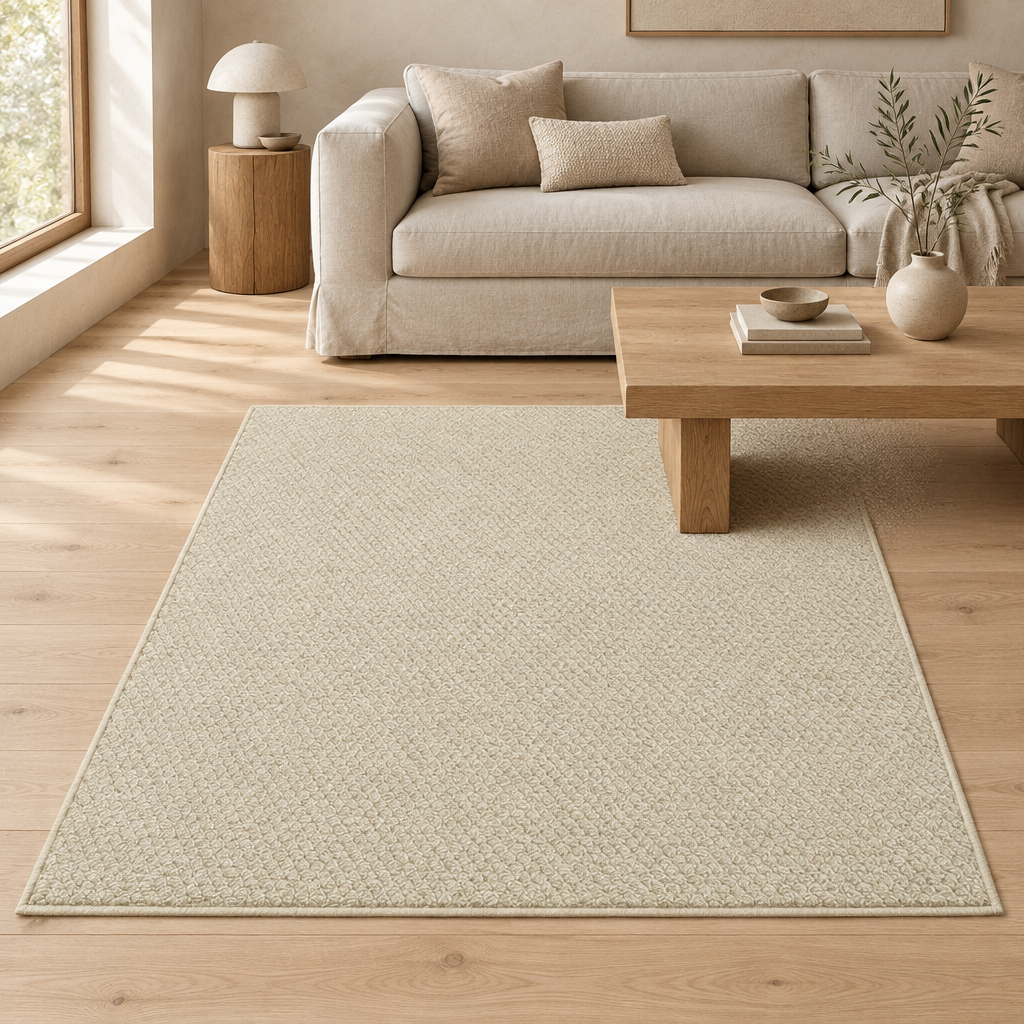
For most UK living rooms, a 160 x 230 cm rug suits a two seater sofa and a 200 x 300 cm rug suits a three seater, laid so the front legs of the sofa and chairs sit on it. The rug should be at least as wide as the sofa, and ideally a little wider. Below is how to size a rug for a living room, a bedroom with a single, double or king bed, a dining table and a hallway, with a size table at the end.
The most common mistake: a rug that is too small
A small rug floating in the middle of the floor, with the furniture standing around it, makes a room look smaller and the furniture look disconnected. In almost every case, the right rug is bigger than the one you first think of. If you are between two sizes, choose the larger one. Marking the size out on the floor with masking tape first shows you exactly where the furniture will sit.
What size rug for a living room
There are three ways to lay a living room rug.
Front legs on
This is the layout that works in most UK living rooms. The rug sits in front of the sofa and armchairs, with their front legs resting on it and the back legs on the floor. It joins the seating into one group without needing a rug the size of the room.
Aim for the front legs to sit around 15 to 20 cm onto the rug, and for the rug to run at least the full length of the sofa, ideally 15 to 20 cm beyond each end. A typical two seater is around 150 to 190 cm long, so a 160 x 230 cm rug laid lengthways in front of it works well. A three seater is usually around 200 to 230 cm, which needs a 200 x 300 cm rug.
All legs on
In a larger room, a rug big enough for every leg of the sofa, chairs and coffee table to stand on it creates a clearly defined seating area. This usually means 200 x 300 cm or larger.
Coffee table only
A smaller rug under just the coffee table, with no furniture on it, is the layout to avoid in most rooms. It only really suits a very small room or a reading corner.
Leave a border of floor
Whichever layout you choose, leave some bare floor between the rug and the walls. Around 30 to 45 cm is ideal, and at least 20 cm in a small room. A rug that runs right up to the skirting boards looks like fitted carpet.
What size rug for a bedroom
The usual placement is under the bottom two thirds of the bed, laid across it, so the rug extends out on both sides and at the foot. Aim for around 45 to 60 cm of rug showing either side of the bed.
UK mattresses are 90 cm wide for a single, 135 cm for a double, 150 cm for a king and 180 cm for a super king, so the rug needs to be the mattress width plus roughly 90 cm to a metre.
For a single bed, a 120 x 180 cm rug laid across the lower part of the bed works well, or a small rug alongside the bed if it stands against a wall. For a double, a 160 x 230 cm rug laid across the bed, with the 230 cm side running from side to side, leaves around 45 to 50 cm each side. For a king or super king, choose 200 x 300 cm, laid the same way.
If your bed has a solid base that sits right on the floor, or you prefer bare floor under the bed, use a pair of smaller rugs or runners, one on each side. An 80 x 160 cm rug either side of a double or king is a neat alternative. Our Japandi bedroom ideas have more on laying out a calm bedroom.
What size rug for a dining table
A dining rug needs to be big enough for the chairs to stay on it when they are pulled out. Otherwise the back legs catch on the edge every time someone sits down. Allow around 60 to 75 cm of rug beyond the edge of the table on every side.
For a four seater table of about 120 x 80 cm, that means a rug of at least 200 x 240 cm, so 200 x 300 cm is a good fit. A six seater table of about 180 x 90 cm on a 200 x 300 cm rug leaves about 55 cm at the sides and 60 cm at the ends, which just works with slim chairs. For more room, or a larger table, look for 240 x 340 cm or more.
Choose a flat weave or a low pile for a dining room. Chairs slide easily on it and crumbs are easier to clear than from a deep pile.
Runners for hallways
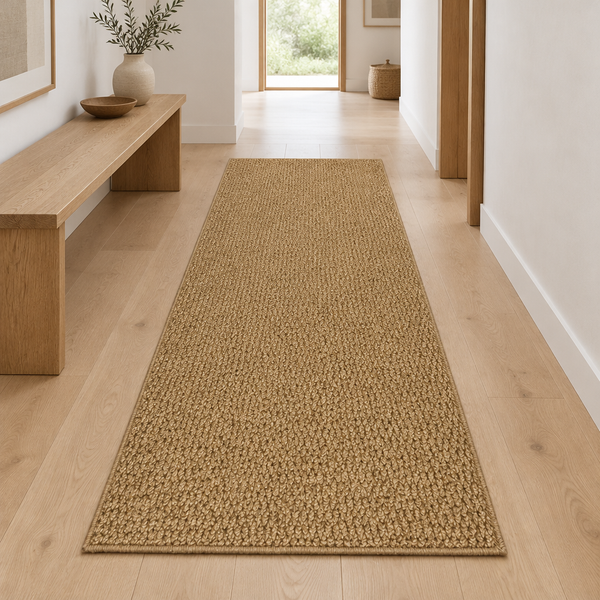
A hallway runner should leave some floor showing on each side, ideally around 10 to 15 cm, so a 60 cm wide runner suits a narrow hallway of about 85 to 90 cm, and an 80 cm runner suits a wider one. Leave around 15 to 30 cm of floor at each end, and make sure doors can open over it. Our guide to small hallway storage ideas covers the rest of the hall.
Our rugs and their sizes
The Ashibetsu flatweave rug has the fine grain of a sisal weave but is woven from polyester, so it is soft underfoot, can be machine washed on a cool gentle cycle and has a non slip rubber backing. It comes as runners of 60 x 180 cm and 80 x 240 cm, and in 100 x 200, 100 x 300, 120 x 300 and 200 x 300 cm (all approximate), in beige, camel or grey. Its flat weave makes the 200 x 300 cm size a practical choice under a dining table.
The Shirakawa braided wool rug is cords of braided wool, hooked by hand and laid in rectangles one inside the next, with no printed pattern. It is made to order in 90 x 150, 120 x 180, 160 x 230 and 200 x 300 cm, in oatmeal, cream or light grey.
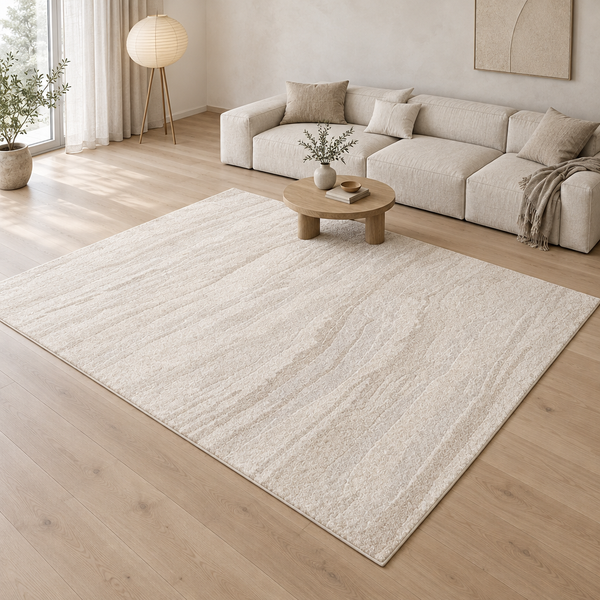
For softness underfoot in a bedroom or living room, the Miyako ivory plush rug has a thick pile, plain or with carved lines or a ribbed centre, in 80 x 160, 120 x 160, 160 x 230 and 200 x 300 cm. The Ikoma stone wave plush rug has a short, dense pile with tonal streaks like layered stone, in sand or stone, in 80 x 160, 120 x 160, 140 x 200, 160 x 230 and 200 x 300 cm.
Rug size table
| Where | Layout | Typical rug size |
|---|---|---|
| Living room, two seater sofa | Front legs on | 160 x 230 cm |
| Living room, three seater sofa | Front legs on | 200 x 300 cm |
| Large or open plan living room | All legs on | 200 x 300 cm or larger |
| Single bed | Across the lower part of the bed | 120 x 180 cm |
| Double bed | Across the lower two thirds | 160 x 230 cm |
| King or super king bed | Across the lower two thirds | 200 x 300 cm |
| Either side of a double or king | Pair of small rugs | 80 x 160 cm each |
| Four seater dining table | Chairs on when pulled out | 200 x 300 cm |
| Six seater dining table | Chairs on when pulled out | 200 x 300 cm (just) or 240 x 340 cm |
| Narrow hallway | Runner | 60 cm wide |
| Wider hallway | Runner | 80 cm wide |
Browse every size in our rugs collection, and see our Japandi living room ideas for how a rug fits into the rest of the room.
Questions
What size rug do I need for a 3 seater sofa?
Usually 200 x 300 cm, laid with the front legs of the sofa on it. The rug should be at least as long as the sofa, and ideally 15 to 20 cm longer at each end.
Is 160 x 230 cm a good size for a living room?
Yes, for a smaller living room with a two seater sofa and an armchair, laid with the front legs on. With a three seater, it will usually look too small.
Should a rug go under the sofa?
Ideally the front legs should sit on the rug, about 15 to 20 cm in. That joins the sofa and chairs into one group, without needing a rug that fills the whole room.
What size rug goes under a double bed?
A 160 x 230 cm rug laid across the bottom two thirds of the bed, with the long side running across it. It leaves soft floor on both sides to step onto.
The pieces in this guide
Everything named above, with the price on it. Free delivery, tracked to your door, and the delivery window stated before you pay.